Why Don't Customers Want to Call Anymore? WhatsApp vs. Phone
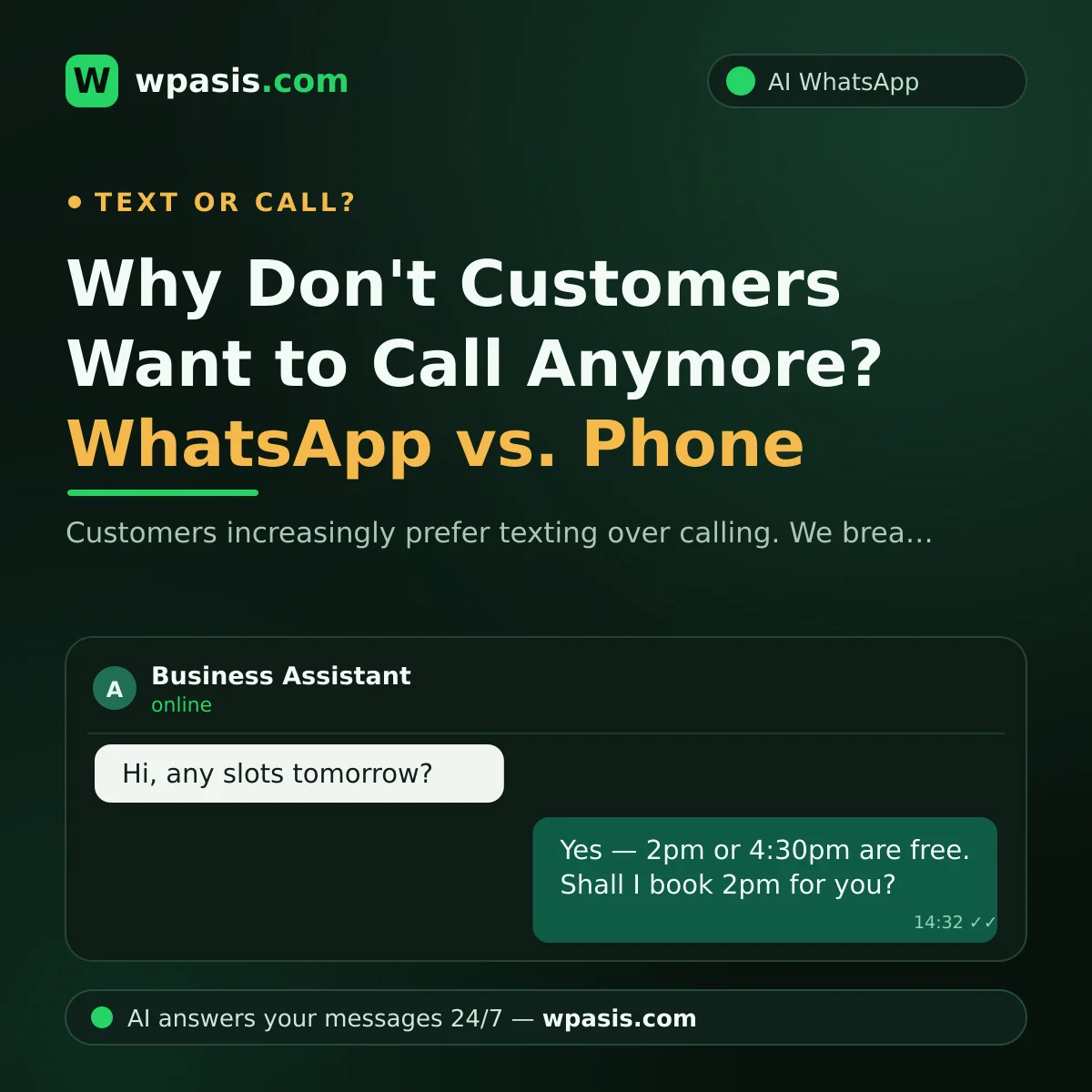
Your phone rings, nobody picks up — then the same number sends a WhatsApp message instead: "Hi, do you have anything available tomorrow?" Or they skip the call entirely and go straight to text. Sound familiar? So why don't customers want to call anymore?
It's one of the shifts business owners mention most often, across almost every industry. The answer isn't "customers got lazy" — it's that the way people communicate has genuinely changed.
Let's look at the reasons behind the shift, the situations where the phone still wins, and how your business can adapt.
Why Don't Customers Want to Call? Four Core Reasons
1. Phone anxiety is real
Especially for younger customers, calling a stranger is often a genuine hurdle. Not being able to script what you'll say, not knowing the tone you'll get back, wondering "what if they're busy"… all of it delays the call — often forever.
Texting carries none of that pressure. You write the message, delete it, rewrite it. The other person reads it whenever suits them. Nobody feels like they're keeping anyone waiting.
And it's not only the young: people of every age hesitate over prices or worry their question is silly. Writing removes that embarrassment.
2. Texting leaves a record
You agreed on "Tuesday at 2 p.m." over the phone. Will the customer remember tomorrow? What was the price, the address, the document to bring?
On WhatsApp, everything stays in writing. The customer scrolls up whenever they need to, copies the address into their maps app, shows the quote to their partner.
That helps you too. The "that's not what I said" argument disappears — when there's a dispute about an appointment time, the conversation is right there.
3. You can text at work — you can't call
Say your customer is in a meeting, on a shift, at a register, or in a classroom. They can't call you without stepping out to find a quiet corner.
But they can send a message: forty seconds to type it, phone back in the pocket, back to work. When you reply, they read it on their lunch break.
Calls are synchronous — both people free at the same moment. Messaging isn't, which is why it's become the practical channel for working people.
4. The fear of being "sold to" on the phone
People assume that if they call, the conversation will drag on, the other side will push, and hanging up will be awkward. Someone who just wants a price doesn't want a ten-minute pitch.
Texting removes that risk. They ask, get their answer, and think it over — no pressure. Ironically, a customer who feels no pressure often finds it easier to say yes.
So Is the Phone Dead?
No. And it's worth saying clearly — "nobody calls anymore" is just as wrong.
The phone still wins in certain situations:
- Emergencies. A burst pipe, a car stranded on the road, a sick pet. Nobody types and waits in those moments.
- Complex topics. Anything needing real back-and-forth: half an hour of typing collapses into a five-minute call.
- Certain customer groups. Older customers, people uneasy with technology, people who dislike typing — they'll always exist.
- Moments that need trust. A large amount of money, a sensitive matter, a first-time engagement — people want to hear a voice.
The right move isn't shutting down the phone. It's giving customers the choice: let callers call and texters text — and make sure neither goes unanswered.
How Does a Business Adapt to This Shift?
Make WhatsApp visible
If customers want to text you but can't figure out where, nothing changes. Put your WhatsApp number on your Google Business Profile, your Instagram bio, your website — even the sign on your door. A clickable link helps too: the customer opens a chat without saving your number.
Take response time seriously
This is messaging's biggest trap. Customers love to text — and hate to wait.
Miss a call and the customer assumes you're busy. But if the message shows read receipts and two hours pass in silence, they read it as indifference. Counterintuitive, but messaging creates a faster reply expectation than calling. We've broken down what that delay costs in the cost of slow replies to customer messages.
A quick calculation (pure assumptions — swap in your own numbers): suppose you get 30 messages a day and each takes about three minutes. That's an hour and a half of messaging per day — fragmented, squeezed between jobs.
Separate first contact from deep conversation
The most efficient model: WhatsApp for first contact, phone when needed.
The customer texts and gets the basics — price range, hours, availability, address. If the topic is complex, you offer: "Happy to give you a quick call if that's easier." You keep the customers who prefer texting, and you move the conversations that genuinely need a voice onto the phone.
This can also cut your call traffic: in many businesses, a large share of calls are one-line questions anyway — "Are you open?", "How much?", "Any space tomorrow?" Keep a tally for a week and see if that's true for your line.
Be ready for the repeat questions
Most incoming messages are near-identical. Opening hours, prices, location, parking, card payments…
Answering these well once and keeping the answers ready saves real time. The next step up is automating them — how to set up a WhatsApp auto-reply is a good place to start.
Does This Vary by Industry?
Yes — significantly.
Where texting dominates: appointment-based businesses (hair salons, beauty studios, clinics), order-taking businesses, anywhere customers mostly ask about prices. These customers want a short, precise piece of information.
Where texting wins on privacy: some things are hard to ask out loud; people find them easier in writing. Here WhatsApp sometimes becomes the only channel customers are comfortable using.
Where the phone stays strong: emergency services, high-value sales involving negotiation, businesses with an older customer base.
The easiest way to find out where you sit: count last week's calls and messages. The numbers will tell you the truth.
What Happens When the Messaging Load Grows?
You made WhatsApp visible and customers started writing — great. But now you're serving customers, answering the phone, and typing replies, all at once.
You have three options:
- Deal with messages later. Cheapest, riskiest. Late reply = lost customer.
- Assign someone to it. Works, but costs money and is limited to working hours.
- Automate it. Let AI answer the repeat questions, and let the conversations that genuinely need you reach you.
The third option has become genuinely accessible in recent years. That's exactly what WpAsis is built for: it connects to your existing WhatsApp number, draws on your own business information, replies to customers on your behalf 24/7, and takes appointments and orders. When needed, you take over the conversation from the dashboard.
Setup is done with a QR code — no code, no technical skills. For current pricing and details, visit wpasis.com.
Frequently Asked Questions
Is this shift away from calling actually permanent?
The reasons behind it are structural: texting leaves a record, fits between tasks, and creates no pressure to keep anyone waiting. These aren't a passing trend — they're inherent advantages of the medium. The phone won't disappear, but as a first-contact channel, messaging keeps gaining ground.
If I lean into WhatsApp, should I remove my phone number?
No — keep it. The call channel must stay open for emergencies, complex topics, and customers who prefer it. The goal isn't shutting down the phone; it's opening a door for those who'd rather write. Running both together is healthiest.
How fast should I reply to messages?
No fixed rule, but customers expect faster replies to messages than to missed calls. An answer hours later is often too late — the customer may have already messaged someone else. If you can't reply instantly, at least send a "Got your message — we'll be right with you" acknowledgment to prevent the impression of indifference.
Does keeping customer chats create data protection issues?
Your obligations — under the GDPR, UK GDPR, or your local privacy laws — apply to WhatsApp conversations too. The core principles: don't collect unnecessary data, don't use it beyond its purpose, and keep customers informed. We cover the topic in GDPR and WhatsApp: what businesses need to know, but for your specific situation, get definitive advice from a legal professional.