WhatsApp Chatbot for Business: The 2026 UK Guide
A WhatsApp chatbot for business is an automated software tool that uses the WhatsApp Business Platform to engage customers, answer queries, and complete sales transactions without direct human involvement. It acts as an invisible digital assistant, available 24/7, allowing UK companies to offer instant support and conversational commerce at scale. This guide explores how British businesses can leverage this technology effectively in 2026.
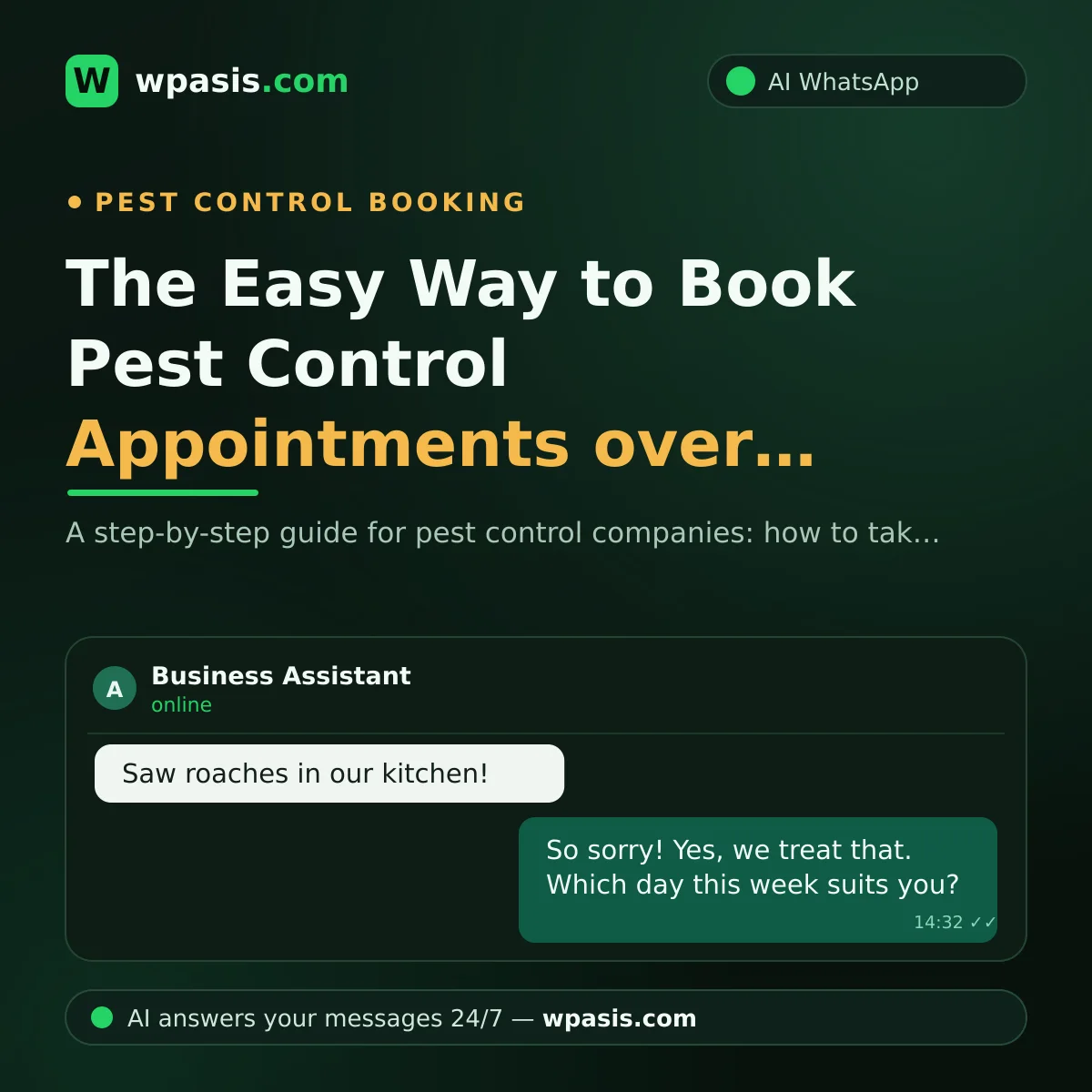
- WhatsApp is the most popular messaging app in the UK, with penetration exceeding 75% of the population.
- Implementing a chatbot can reduce a business's customer support costs by up to 30%.
- UK consumers expect instant responses on messaging channels, making proactive automation essential for maintaining competitive satisfaction levels.
Table of Contents
- Why UK Businesses Are Adopting WhatsApp Chatbots in 2026
- Key Features of an Effective Business WhatsApp Chatbot
- How to Set Up a WhatsApp Chatbot for Your UK Business (Step-by-Step)
- Automation vs. Human Agents: Striking the Right Balance
- Compliance and Best Practices for WhatsApp Marketing in the UK
- Measuring the ROI of Your WhatsApp Chatbot
- Frequently Asked Questions
For more, see our pest control businesses page.
Why UK Businesses Are Adopting WhatsApp Chatbots in 2026
UK businesses are adopting WhatsApp chatbots because the platform's high penetration rate and unmatched open rates make it the most effective channel for instant, conversational customer service.
The UK has one of the highest smartphone penetrations in the world, and WhatsApp is overwhelmingly the dominant messaging app. For British consumers, WhatsApp is not just for family chats; it is increasingly the expected channel to communicate with high-street shops, utilities, and online services. A chatbot allows these companies to be present on this channel around the clock.
By 2026, UK companies are deploying sophisticated AI agents that handle billing questions, track parcels, and recommend products. This shift is driven by a clear economic reality: hiring a dedicated support team is expensive. A chatbot provides a consistent, automated first line of response that scales across thousands of conversations. The result is lower overheads, faster response times, and an improved customer experience.
Key Features of an Effective Business WhatsApp Chatbot
An effective business WhatsApp chatbot combines AI-powered natural language processing, interactive menus, secure payment integration, and CRM connectivity to manage complete customer journeys end-to-end.
To deliver real value, a chatbot must do more than send automated replies. The first essential feature is integration. Your chatbot should plug directly into your CRM, e-commerce platform, or booking system. This allows it to access live data, such as order status or appointment availability, providing accurate answers to your customers.
Another crucial feature is the ability to handle rich media. Instead of just sending text, the bot should share PDFs, promotional images, and location pins. For a UK audience, tone and language are particularly important. The chatbot should mirror your brand's voice, whether professional, friendly, or pragmatic. It must also offer seamless handover to a human colleague when it detects frustration or complexity.
Finally, look for analytics. Understanding what customers ask the bot ensures you can continually improve the experience. Many UK service providers, such as pest control businesses, use these features to streamline their booking processes.
How to Set Up a WhatsApp Chatbot for Your UK Business (Step-by-Step)
To set up a WhatsApp chatbot, you must obtain a dedicated business number, choose a provider, map out your conversation flows, and rigorously test the system before launch.
Getting started is easier than most UK business owners expect. First, you need a dedicated WhatsApp Business account. Do not use your personal number. Register through the WhatsApp Business App or the Business API, depending on the size of your operations. Next, define your objectives. Are you aiming to increase sales, reduce support tickets, or automate confirmations?
Map out the most common customer journeys for your business. Draft scripts for these scenarios. Consider offering discounts, asking for details, or directing users to a payment link. Once your conversation flow is ready, connect your chosen tools. The WpAsis platform provides intuitive ways to build these automations without extensive coding knowledge.
Finally, conduct a pilot test. Use your team or a small group of loyal customers to test the bot. Make sure the tone reflects British communication styles. Refine and then scale up.
Automation vs. Human Agents: Striking the Right Balance
The most successful UK businesses use WhatsApp chatbots to handle routine questions while seamlessly escalating complex or sensitive cases to human agents.
It is tempting to automate every possible conversation, but that strategy often leads to customer frustration. In the UK, where consumers value politeness and empathy, completely robotic interactions can harm your brand. The key is smart escalation. A well-designed chatbot acknowledges the customer's issue and, when needed, immediately offers to connect them with a human representative.
For example, handling a refund, a complaint about a service, or a complex technical failure requires a human touch. The chatbot can pre-qualify the problem, gather the necessary details, and route the conversation to the right team member. This hybrid model ensures efficiency without sacrificing quality.
It also boosts employee morale, as your support staff can focus on meaningful problem-solving rather than repetitive questions. Businesses that master this balance often see significant improvements in customer satisfaction. British e-commerce brands and local services alike are adopting this layered approach. Learn how to write effective customer messages on WhatsApp to elevate your strategy.
Compliance and Best Practices for WhatsApp Marketing in the UK
UK businesses must adhere to GDPR, the Privacy and Electronic Communications Regulations (PECR), and WhatsApp's strict business policies to avoid penalties when using chatbots.
Operating a WhatsApp chatbot in the UK requires strict adherence to data protection laws. The UK GDPR governs how you collect and store customer data, while PECR sets specific rules for marketing communications. This means you cannot send promotional WhatsApp messages to people without their explicit consent.
Buying a phone list to generate leads is not just ineffective; it is illegal and can result in fines. Instead, focus on organic growth. Invite customers to opt in via your website, over email, or at the point of sale. When you do send campaigns, personalise them and always provide an easy way to opt out.
WhatsApp users can block a business instantly, damaging your sender reputation. To protect your business further, be aware of the technical framework. Sending generic bulk messages is strictly monitored. It is wise to review the risks and penalties of WhatsApp bulk messaging to understand the boundaries of acceptable use.
Measuring the ROI of Your WhatsApp Chatbot
To measure the return on investment of a WhatsApp chatbot, UK businesses should track metrics such as response time, resolution rate, cost per conversation, and overall customer lifetime value.
To measure the return on investment of your chatbot, start by defining key performance indicators. The most obvious metric is time savings. Calculate how many hours your team spends on repetitive questions each week. A chatbot will drastically reduce that number. Next, track response time.
Consumers in the UK expect quick replies, and bots can respond in milliseconds. This speed directly impacts conversion rates. If you use the chatbot for marketing, monitor click-through rates and the number of sales generated through the platform. Look at your customer retention data.
Chatbots can send automated renewal reminders or birthday offers, increasing loyalty. Finally, consider the overall return on invested capital. Compare the monthly cost of the software against the salary costs saved. Many UK small businesses find their chatbot pays for itself within the first quarter.
You can further boost your digital strategy by pairing your automation with a targeted SEO audit package for small UK businesses.
You can explore WpAsis platform.
Frequently Asked Questions
How much does a WhatsApp chatbot for business cost in the UK?
Costs in the UK vary from free basic tools to around £100–£500 per month for advanced AI-powered platforms, depending on message volume and features.
Is WhatsApp chatbot safe for handling UK customer data?
Yes, if you use the official WhatsApp Business API and follow strict GDPR and PECR guidelines, ensuring data is encrypted and stored in compliant locations.
Can a WhatsApp chatbot replace my customer service team?
No, chatbots are best used to automate repetitive tasks and answer simple queries, allowing your team to focus on high-value interactions that require human empathy and complex problem-solving.
What is the difference between WhatsApp Business App and WhatsApp Business API?
The Business App is for small, local businesses talking to a limited audience, while the API is for medium and large businesses that need to integrate with back-end systems and send high-volume, automated messages.