Tailor Order Tracking on WhatsApp: End the Alteration Questions
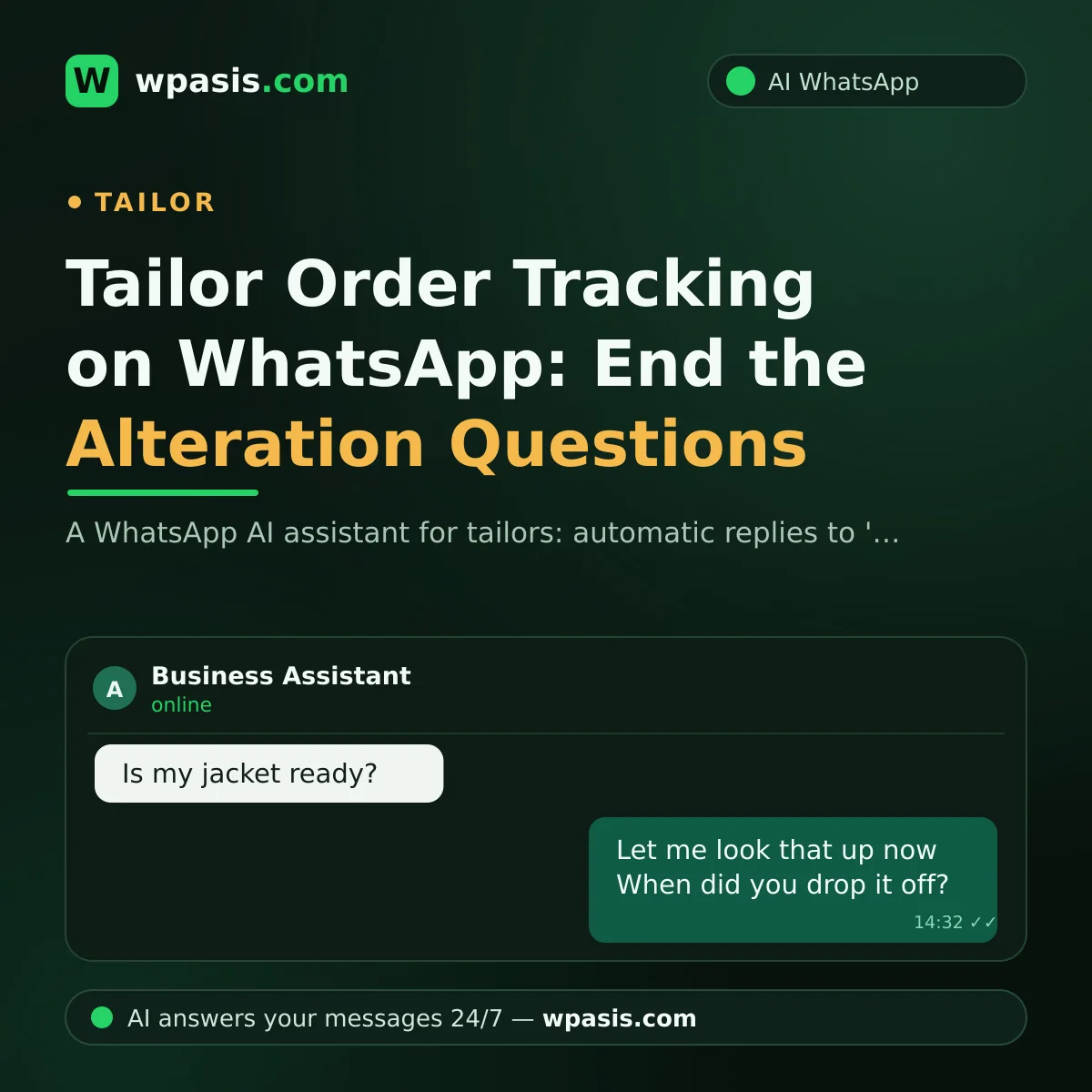
You're turning up a hem and the phone rings; you're mid-fitting and a message lands: "Is my jacket done?", "How much to replace a zip?", "Can I come in for measurements tomorrow?" In most workshops, tailor order tracking is still jobs held in your head and a day full of interruptions. Yet customers now ask everything over WhatsApp and expect a quick reply.
This article shows how that traffic becomes manageable, which questions an AI assistant answers for you, and why setup needs no technical knowledge.
Why Did Tailor Order Tracking Move to WhatsApp?
In the old days a customer dropped off their alteration, took a ticket, and we'd say "pop by next week." Now that same customer writes two days later: "Are my trousers ready?" Calling is a hassle and coming in for nothing wastes time; WhatsApp has replaced both.
Grouping the messages a tailor receives:
- "Ready?" questions: "Is my alteration finished?", "When can I collect it?"
- Appointment requests: "When should I come for measurements?", "Is the fitting day okay?"
- Price questions: "How much for a hem?", "What does relining cost?", "Price for a wedding-dress alteration?"
- General questions: "Are you open on Sunday?", "Do you work on leather jackets?"
You know the answer to almost every one off the top of your head. The problem is putting down the work in your hands to type it dozens of times a day.
Glancing at Your Phone With a Needle in Hand: The Day's Hidden Cost
Say your workshop gets 25 WhatsApp messages a day, and it takes about three minutes to look at each one, set down your work, reply, and get back to it. That's more than an hour a day — and worse, it's interruption mid-stitch. In work that demands attention, the cost of an interruption is greater than the minutes spent: a wrong cut, a skipped dart, a forgotten note.
There's the other side of the coin too: the unanswered message. A customer who writes in the evening — "I have an urgent event, will my dress be ready in time?" — may call another tailor if they hear nothing by morning. In one-person workshops this dilemma is even more draining; we covered it in our article on customer management in a one-person business.
What Does an AI Assistant Do for Tailor Order Tracking?
WpAsis connects to your existing WhatsApp number and answers incoming messages on behalf of your business, 24/7. In a tailor's shop, here's how it plays out:
Instant greeting for "is my alteration ready?"
The moment a customer writes, the assistant greets them, learns which item they're asking about and when they dropped it off, and shares your average turnaround times. If something needs clarifying, it hands the conversation to you; from the dashboard you reply with one message: "Ready, come on by." The customer isn't left hanging, and you don't get up from the machine for every message.
The assistant takes measurement and fitting appointments
For "when should I come for measurements?", the assistant learns a suitable day and time and creates the appointment on your behalf. For customers who forget a fitting, reminder messages make a big difference; for ready-made templates, see appointment reminder message examples.
Pre-information on price questions
An alteration price varies by fabric, style, and workmanship, so an exact price over WhatsApp is often the wrong move. The assistant explains this kindly: it learns which job the customer means, passes along the general ranges you've entered — or your message that "prices vary from item to item, we'll give an exact figure in the shop" — and asks for a photo if needed. You spend your time on customers at the decision stage, not on haggling.
It collects order requests
For curtain-making, embroidery, or bulk work, the assistant asks for quantity, fabric, and delivery date and puts a tidy order request in front of you — instead of a scattered pile of messages.
Let's Say 20 of 25 Daily Messages Are Routine
Concretely: if 25 messages come in a day and 20 sit in the "is it ready, how much, when should I come" triangle, the assistant handles those 20 instantly with your defined answers. The 5 left for you genuinely need your judgment: a custom-tailoring detail, a tricky alteration decision, a fabric choice. Technology doesn't cut you off from the customer; it leaves you only the conversations that need real craft.
Setup: Scan the QR, Describe Your Shop
No technical knowledge required. You connect your existing WhatsApp line by scanning a QR code, just like opening WhatsApp Web. Your number doesn't change and customers feel no difference; they only notice replies now always arrive on time.
Next, teach the assistant about your shop: opening hours, average turnaround times, the jobs you take and don't, your pricing policy, address, and deposit rules. Write these into the knowledge base once and the assistant speaks in your voice. You monitor every conversation from the dashboard and take over with a single tap. With foreign customers, multi-language support lets the assistant reply in their own language.
Your Door Is Open Even When the Shop Is Closed
Most tailor shops are closed evenings and Sundays — exactly when an alteration crosses a customer's mind. A jacket pulled from the wardrobe, an approaching wedding, trousers that no longer fit. Because the assistant works 24/7, a customer who writes on a Sunday evening still gets an instant reply; their appointment is booked, their question answered. On Monday morning, instead of a heap of overnight messages, you find organized appointments and summarized requests on the dashboard.
One more advantage: every customer's full chat history stays on the dashboard. Instead of racking your memory over "what did this customer drop off, what did we discuss?", you just open it and look — a digital, un-losable version of notes scribbled in a notebook margin.
Frequently Asked Questions
Will my customers realize they're talking to a bot, and will it bother them?
The assistant writes in the tone you set — warm and natural. What the customer really wants is a quick, correct answer; a reply within seconds at 10 p.m. is a big plus for most people. If you prefer, you can have the assistant introduce itself as a digital assistant.
How will the assistant know whether the alteration is ready?
It shares the turnaround and process details from your knowledge base, collects the customer's order details, and hands the conversation to you when something needs confirming. You check the status from the dashboard and settle it with one message. The aim isn't to remove you, but to take routine traffic off your shoulders.
I don't want to share prices over WhatsApp — will the assistant still work?
Yes; you fully control price communication. The assistant can give an answer you've approved, such as "our prices vary by job, we'll give exact details in the shop," or share a range only for jobs you specify. If you like, it forwards price questions straight to you.
Do I need computer skills or extra equipment to set it up?
No. Your existing WhatsApp line connects via a QR code; there's no code to write, no program to install, no new device to buy. Preparing your knowledge base, you just describe your shop in your own words.
In tailoring, reputation is built on keeping your word and the quality of your work; but in the customer's eyes, the first impression is how quickly you reply. You don't have to carry both at once. Try WpAsis on your own line, leave the routine questions to the assistant, and focus on your needle and thread: request a free demo at wpasis.com.