Managing Music School Enrollment and Lesson Schedules on WhatsApp
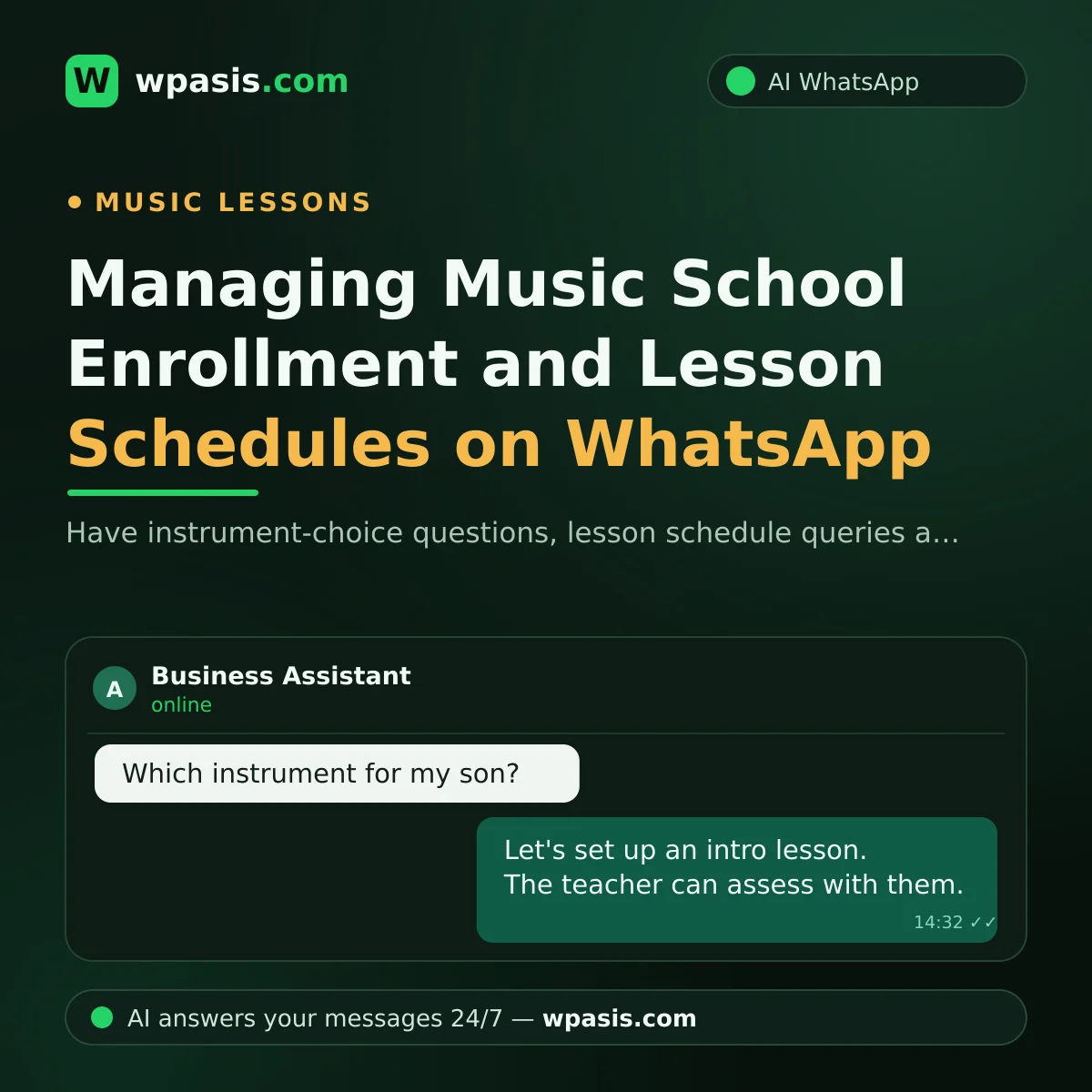
If you run a music school, you know this scene well: you're in a piano lesson with a student, and the phone buzzes over and over. One person asks, "Which instrument is right for my son?" another wants to confirm the time of Wednesday's lesson, and a parent is requesting a make-up lesson for a daughter who's ill. During music school enrollment season, this traffic doubles or triples; burying yourself in the phone between lessons becomes the daily routine. In this article, we'll show how to bring order to that load with a WhatsApp AI assistant.
The Hidden Load of Music School Enrollment Season
Music education is largely one-on-one work. That means the instructor can't look at the phone while teaching, and a music school's working hours almost never line up with the hours parents send messages. Parents mostly write in the evening, after work, or at the weekend — precisely when you're in a lesson.
Let's say you get 35 messages a day, and two-thirds of them cluster around three topics: instrument choice, the lesson schedule, and make-up lessons. If you spend about two minutes on each message, that's more than an hour a day going to repetitive exchanges alone. It's only an assumption — but look at the past week on your own phone and you'll find the picture familiar.
The real loss, though, isn't time; it's opportunity. A parent who writes "do you offer guitar lessons?" and doesn't hear back for a few hours signs up with the second school on their list. In enrollment season, speed means student numbers, plainly.
Instrument-Choice Questions: Every Parent's First Stop
The classic opening question from parents writing to a music school is a familiar one: "My child is 7 — which instrument should they start with?" It's followed by "Piano or violin?" "What age can they begin?" "Do we have to buy an instrument for home?" These questions matter, because the parent is really gauging your school's approach, seriousness and attentiveness.
A WhatsApp AI assistant answers these in your approach: it explains which instruments you teach, which styles you recommend for which age ranges, and whether you offer a trial or intro lesson. It nudges an undecided parent toward a natural next step — "If you like, let's set up an intro lesson so our instructor can assess your child together with you." That way a question-asking parent turns from a message awaiting reply into a prospect with a booking.
Let's underline this: the assistant doesn't make pedagogical decisions; it conveys the approach you've written into your knowledge base. Content like which instrument to recommend at which age is entirely under your control.
The Lesson Schedule: "What Time Was Our Wednesday Lesson?"
In a one-on-one setup, every student has a separate schedule, and that's a source of confusion for parents. "Is there a lesson this week?" "What time was ours?" "Will there be lessons over the holidays?" — these questions come round again every week.
The assistant learns your lesson setup and general calendar from the knowledge base: which styles run on which days, term dates, holidays, the school's working hours — it tells everyone the same, accurate answer. When a student-specific time is needed, it hands the conversation to your panel; you see the situation at a glance and write a short confirmation. The load of routine questions stays with the assistant; person-specific decisions stay with you.
Pre-lesson reminders are a natural part of this order, too. Forgotten lessons waste the instructor's hour and grow the make-up backlog; a gentle reminder message breaks that chain at the source. For ready-made templates, see our appointment reminder message examples article.
Make-Up Lessons: The Music School's Never-Ending Puzzle
The make-up lesson is the most exhausting part of running a music school. A child falls ill, a school exam gets in the way, a parent goes on holiday; the lesson is cancelled, and now you have to find where in the schedule to fit it. And every make-up conversation is a long exchange: "Thursday?" "No — Friday?" "No instructor on Friday…"
The assistant makes this easier from both ends.
It clarifies the rules
You write your make-up policy — how much notice earns a make-up right, and the window in which make-ups can be used — into the knowledge base; the assistant explains the same rule, with the same courtesy, to every parent. The rule discussion is settled on clear ground from the start, rather than between instructor and parent.
It collects and organizes requests
When a cancellation message comes in, the assistant records it, takes the make-up request, and passes it to your panel with the parent's preferred days. Instead of getting lost in scattered exchanges, you see a tidy make-up list in front of you. The decision is still yours; the assistant simply lays the puzzle pieces on the table.
How Does AI Answer Music School Enrollment Questions?
To pull it together. A WhatsApp AI assistant like WpAsis connects to your school's existing WhatsApp line with a QR code; no technical knowledge needed. After that, it:
- Replies to parent messages 24/7, in your school's voice; whether you're in a lesson or it's the middle of the night, no one is left unanswered.
- Learns your instrument specialties, your age-based approach, your lesson setup and your make-up rules from your knowledge base.
- Takes enrollment and intro-lesson requests, gathers the details, and passes them to you neatly.
- Answers frequently asked questions (is an instrument required, how long is a lesson, are there recitals) consistently.
- Keeps every conversation viewable in the panel; on sensitive matters, a human takes over with a single tap.
If you run the school on your own or with one or two instructors, the value of this setup multiplies; for anyone wrestling with a similar picture, our customer management in a one-person business article will help point the way.
Frequently Asked Questions
What does the assistant base its instrument recommendation on?
Entirely on the approach you've written into your knowledge base. You decide which styles you recommend for which age group; the assistant doesn't step outside that frame, and in undecided cases it points the parent toward an intro lesson or to you.
Can the assistant know a student's specific lesson time?
The assistant answers general schedule, working hours and calendar questions directly. When a person-specific time confirmation is needed, the conversation drops into your panel; you see it at a glance and settle it with a short confirmation. The routine load stays with the assistant, the personal detail with you.
Does the assistant arrange the make-up lesson on its own?
No. The assistant records the cancellation notice, explains your make-up rule, and collects the parent's preferred days. You make the final placement according to the instructor's schedule; the assistant organizes the process and leaves the decision to you.
Won't automatic replies feel cold to parents?
Because you set the tone, the replies go out in your school's voice — warm and respectful. What parents notice isn't "talking to a robot"; it's getting fast, accurate answers to their questions, day or night.
It's possible to run a music school without burying yourself in the phone between lessons and without keeping parents waiting. Try WpAsis free on your own WhatsApp line: scan the QR code, add your specialties and rules, and leave the rest to the assistant. For a free demo, visit wpasis.com.