Jeweler WhatsApp Communication: Fast Answers to Customer Questions
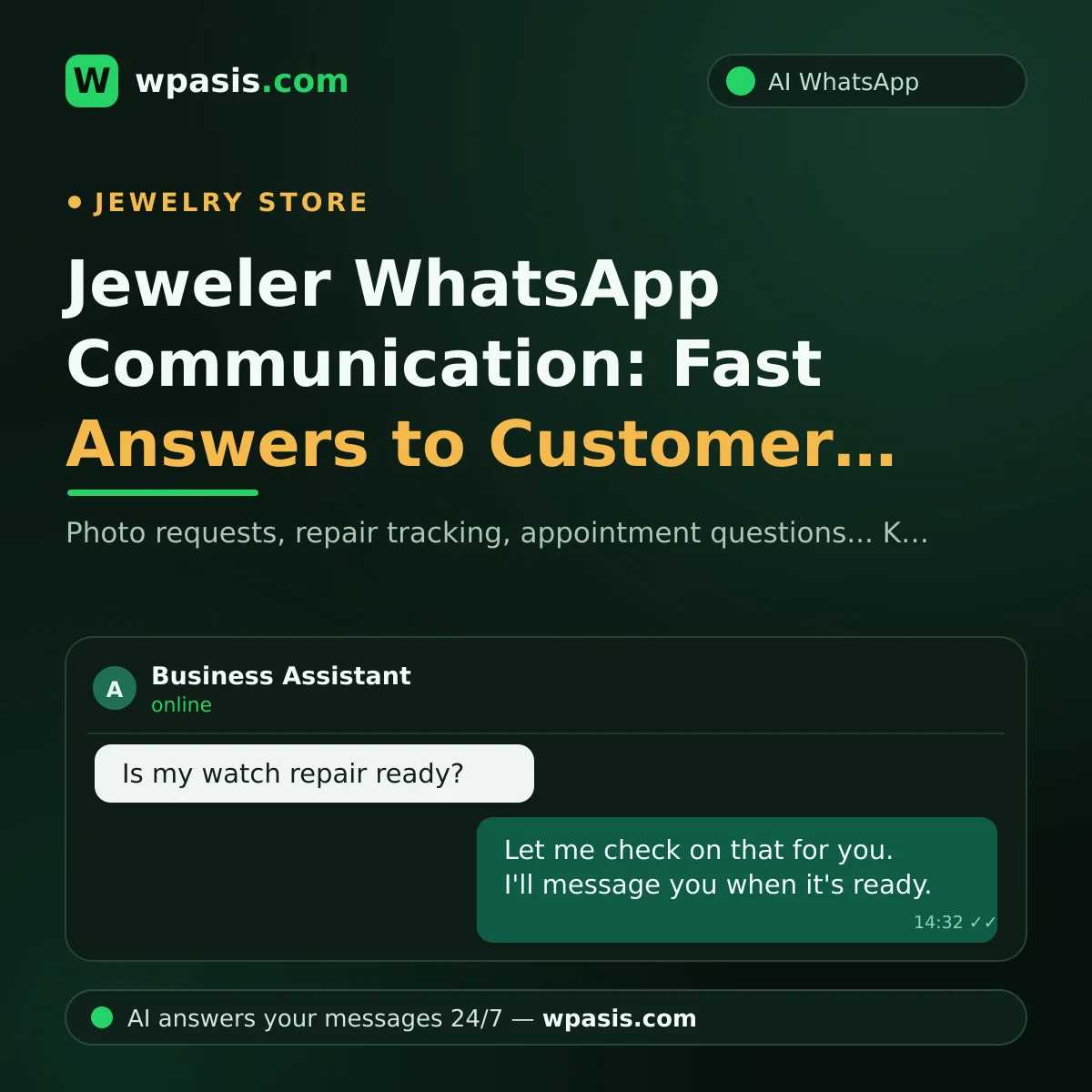
A customer asking for a photo of a bracelet in the window, a couple wanting ideas for an engagement ring, a woman asking "is the necklace I left for repair ready yet?"... A jeweler's WhatsApp line fills up with messages like these all day long. And in this trade, communication has a delicate side: prices can shift by the day — even by the hour — and every figure you put in writing commits you. So is it possible to reply quickly and protect that sensitivity at the same time?
In this guide, we'll explain how an AI assistant connected to your existing WhatsApp line handles photo requests, repair tracking and appointment questions — and why and how it steers price questions toward an in-person conversation.
An Ordinary Day on a Jeweler's WhatsApp Line
You're at the counter, and there's a couple inside looking at wedding bands. Your phone buzzes one message after another:
- "Could you send a photo of that twisted gold bangle in the window?"
- "Is the watch I left for repair ready?"
- "When can we drop by to get a ring size?"
- "How much is that bangle today?"
Let's say 25 messages come in a day. Keeping up with them without dividing the attention you owe the customer in front of you is almost impossible. But every message left unanswered is a customer who might take their next step at another jeweler.
Jewelry is a face-to-face business built on trust — that's true. But first contact is now mostly made over the phone. Replying to that first message quickly and properly is the invisible step that gets a customer through your door.
The AI's Role in Jeweler WhatsApp Communication
WpAsis is an AI assistant that connects to your existing WhatsApp number by scanning a QR code. Your number doesn't change, and your customers keep messaging you in the same place; no code or technical knowledge is required. Once it's connected, the assistant answers incoming messages on your behalf around the clock, while you watch every conversation from the panel and step in whenever you like.
Photo Requests
When a customer asks for a photo of a particular piece, the assistant clarifies the request: which product group (ring, bracelet, necklace, watch), which style, what it's for (engagement, gift, investment)? The clarified request drops into the panel; you then share the right photo through the conversation yourself, or invite the customer into the store. That way the "could you send a photo?" message doesn't go unanswered — but the decision about which piece to show whom stays under your control.
Repair and Order Tracking
How many times a day does "is my necklace ready?" come in? The assistant learns your repair and custom-order processes from your knowledge base: it explains roughly how long jobs take and, when asked, politely sums up where things stand. When a piece is ready, you open the conversation in the panel and let the customer know in a single message. And when a customer asks again in the meantime, the assistant keeps them informed without ever tiring of it, with the same courtesy every time.
The Right Approach to Price Questions: Steering to a Conversation
In jewelry, price moves with the daily market. A figure given in a message can lose its validity the next day, leading to misunderstandings and even a loss of trust. That's why you set the assistant up not to quote figures on price questions: the assistant politely explains that prices change with the current market and invites the customer to call or come into the store.
This approach does two jobs at once. The customer isn't left without a reply — they reach someone; and you're protected from the risks of a written price commitment. What's more, the face-to-face contact made when a customer comes into the store is already the strongest moment for a sale in this trade. The assistant's job isn't to close the sale in a message — it's to carry the customer to that moment.
Mind Trust and Personal Data
A jewelry customer shares information in their messages that hints at their habits and preferences. Handling those conversations with care is both a matter of commercial courtesy and a legal requirement. You can find a general framework for what to watch for in customer messages under data-protection rules like the GDPR in this piece: GDPR and WhatsApp: what businesses need to watch for. For definitive guidance on your own situation, we always recommend consulting an expert.
Where Do Customers Find You?
Most new customers search online first, then message. If you add a WhatsApp link to your Google Business Profile, a customer who finds you can start a message with a single tap — and the assistant answers that first message instantly. We've explained how to do it step by step here: adding WhatsApp to your Google Business Profile.
One more detail: if you have international customers, the assistant's multi-language support comes into play. For jewelers working in a tourist area, replying in their own language to a customer who writes in Arabic, Spanish or another language is often the first step of the sale.
Frequently Asked Questions
Does the assistant really never quote a figure on price questions?
It behaves however you set it up. Our recommendation for jewelers is that, with fluctuating prices, you steer the customer to the phone or the store for current information rather than quote a figure in writing; the assistant applies this rule consistently in every conversation.
How does the assistant know the repair status?
You define your repair and order processes in the knowledge base; the assistant explains the average timelines and how things work accordingly. When a piece is ready, you let your customer know from the panel in a single message.
Will my customers realize they're talking to an AI?
If you like, the assistant introduces itself as an AI assistant; that choice is yours. What the customer really expects is a fast, courteous reply; getting an instant answer to a late-night "is it ready?" doesn't reduce trust — it builds it.
Will my existing number and customer chats be affected?
No. The assistant connects to your existing line via a QR code; your number doesn't change, and your customers keep messaging you in the same place. Every conversation is in front of you in the panel, and you can take over whenever you like.
Jewelry is a business of trust, and trust begins with attention. If you'd like to hand off the rush of keeping up with messages to AI and focus on the customer at your counter, you can try the free demo at wpasis.com. For current pricing, just visit wpasis.com.