Managing International Consultations for a Hair Transplant Clinic With WhatsApp
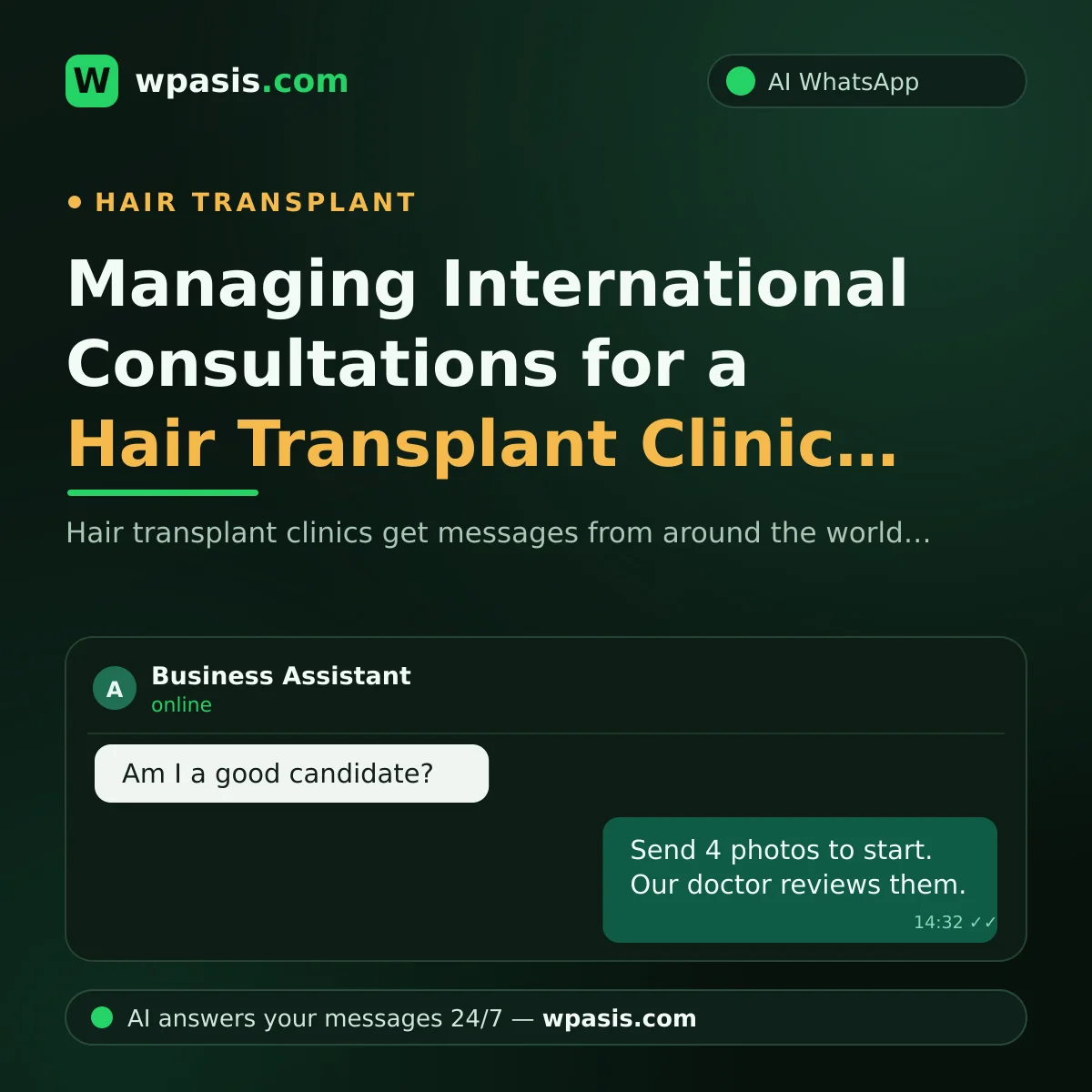
If you run a hair transplant clinic, you already know one thing: your WhatsApp line never goes quiet. Hair transplantation draws people who research across borders, so messages don't come only from your own city, they arrive from different countries and different time zones. Someone writing from London at midnight, someone else sending photos from Riyadh before dawn. Everyone wonders the same thing: "Am I a good candidate, and how does the process work?" In this article we'll explain how to manage this busy, international consultation traffic with AI over WhatsApp, and especially how to set up the photo-based pre-assessment flow.
Why Is a Hair Transplant Clinic So Dependent on WhatsApp?
Someone researching a hair transplant is often writing from another country. They found you through your website, social media, or a friend's recommendation, and their first contact is almost always over WhatsApp, because calling is expensive and, with a language barrier, difficult, while WhatsApp is in everyone's pocket. To add one-tap message links to your site and ads, take a look at our article on creating a wa.me link.
This picture creates two big challenges:
Time difference: Your midnight is your prospective patient's lunch break. If you reply the next afternoon, that person has probably already turned to one of the three or four clinics they messaged at the same time. In this field, speed is the first condition of being chosen.
Language barrier: English, Arabic, German, French, Russian, Spanish. Building a team that can correspond in every language is both hard and costly. Most clinics can keep up with a few languages, and the rest of the messages get muddled through translation apps.
How to Set Up the Photo-Based Pre-Assessment Flow
The backbone of hair transplant consulting is the pre-assessment, and this process is already standard: photos of the person's hair from different angles are requested, a few basic details are collected, and the file is passed to the doctor. The collection part of this flow is one of the things an AI assistant does best.
Here's how the setup works:
- Greeting: When someone writes, the assistant greets them in their own language, briefly introduces the clinic, and explains how the pre-assessment will proceed.
- Photo request: The assistant describes which angles are needed for evaluation: the crown, the frontal hairline, the sides, and the nape area. The person sends the photos within the same chat.
- Basic details: Age, how long the hair loss has been going on, whether they've had a procedure before, the questions you've defined are asked in order.
- Handover to the doctor: The collected photos and details reach your team as one tidy file in the panel. The assessment and eligibility decision are always made by your doctor; under no circumstances does the assistant offer a medical opinion like "you're eligible" or "you'll need this many grafts."
- Follow-up: Once the doctor's assessment is complete, your team shares the result and moves on to planning the process.
The beauty of this flow: the assistant takes on the tiring, repetitive data-collection work, while your doctor deals only with assessment and decisions. No one has to look at a photo that arrives at 3 AM right away, but the person who sent it found someone to engage with in seconds, so they're happy to wait.
An important reminder here: a hair transplant is a medical procedure. Definitive information about eligibility, method, and process can only be given after an examination and a specialist doctor's assessment; the pre-assessment over WhatsApp is only a first step.
Multi-Language Support for a Hair Transplant Clinic
One of the biggest advantages of a WhatsApp AI assistant like WpAsis in this field is multi-language support. Whatever language a person writes in, the assistant replies in that language: English to someone writing in English, Arabic to someone writing in Arabic. No waiting for a translator, no copy-pasting through a translation app.
What this means: without employing a separate consultant for each language, you can reply to a message from anywhere in the world in its own language, instantly. For an international patient, that's a "this clinic knows what it's doing" feeling from the very first message.
The assistant produces all its answers from your knowledge base: your services, your process steps, your organizational details like accommodation and transfers, and your FAQ answers. The better you prepare this base, the sharper the answers; you'll find how to do it in our article on how to build a business knowledge base.
Not Missing a Single Message During Peak Demand
Let's say your clinic gets 60 new messages a day, and half of them arrive outside working hours. With a two-person consultation team, keeping up with that traffic means, at best, replying to some messages hours later. But with the assistant on duty:
- Every message is answered within seconds, whatever the hour.
- Photo and detail collection is completed while you sleep; in the morning you find ready files in the panel.
- During the day your team deals only with the follow-ups on files where the doctor's assessment is done, and with special questions.
- You follow every conversation from the panel and take over any chat whenever you want.
The assistant does the routine work; humans do the work that requires trust and judgment. In the eyes of an international patient, your clinic is positioned as a professional institution reachable in every language, at every hour.
Let's finish with a concrete example: someone from Berlin writes in German on a Saturday night. The assistant greets them in German, explains the process, and collects their photos and basic details. Monday morning your doctor reviews the file, your team shares the result at midday, and a consultation is scheduled. No one waited by the phone all weekend, but the prospective patient was never left without a reply once. That's exactly what makes the difference.
Frequently Asked Questions
Can the assistant decide whether a patient is eligible?
No, absolutely not, and it shouldn't. The assistant only collects photos and basic details and passes the file to your doctor. Eligibility, method, and planning decisions are always made by a specialist doctor; an examination is essential for definitive information.
Which languages can it serve in?
The assistant supports multiple languages; whatever language a person writes in, it replies in that language. This means you don't need to keep a separate consultant fluent in each foreign language for messages coming from different countries.
Can we keep using our existing WhatsApp line?
Yes. WpAsis connects to your current number with a QR code; no technical knowledge required. The number you share in your ads and on your site stays the same, only your response speed and coverage hours change.
What should we watch out for with the photos and personal information sent?
Health data is sensitive personal data; when you collect it, you have privacy-notice and explicit-consent obligations. For the general framework you can read our article on GDPR and WhatsApp; for definitive guidance specific to your process, be sure to consult a legal expert.
To manage your international consultation traffic from a single line, in every language, 24/7, try a free demo at wpasis.com. Setup takes minutes, and the difference is felt from the very first message.