Hair Salon Marketing: Instagram Gets Seen, WhatsApp Gets Booked
Your salon's Instagram looks good. The colour work photographs beautifully, the stories go up regularly, the follower count is respectable. And the chairs are still empty on a Tuesday afternoon.
This is one of the most common pictures in hair salon marketing: plenty of visibility, not much transaction.
The problem usually isn't that Instagram is bad. The problem is asking Instagram to do a job it was never built for. Collecting likes is one job. Filling the appointment book is another.
This post breaks salon client acquisition into three legs: being found, getting booked, and staying in touch. Each has a different role, and none of them substitutes for the others.
Why One Channel Can't Do It All
Think about the path a new client takes before they ever sit in your chair. First they see you somewhere. Then they work out whether you're right for them. Then they have to actually reach you. And finally they decide whether to show up.
Every step of that path asks for something different. The first needs visibility. The second needs trust. The third needs ease. The fourth needs a nudge.
Expecting one app to do all four well isn't realistic. Instagram is strong on the first two. But on the third — the moment someone thinks "right, I'll book" — most salons lose them.
What Instagram Is Actually For: The Window
Instagram is your shop window. People see your work there, get a read on your style, and build the feeling of "I'd go to that place." That's valuable and you shouldn't give it up.
But a window isn't a till. Nobody pays while looking through the glass.
The Instagram DM inbox does not behave like a booking system. Messages land in message requests, notifications get buried, and finding a conversation from last week turns into an archaeology project. And the person running that account is usually the person holding the scissors. You can't check your phone mid-blowout.
What WhatsApp Is Actually For: The Till
WhatsApp is a transaction channel. For a lot of clients it's already the app they message everyone else in, and writing to a number saved in their contacts feels less awkward than DMing an account they've never spoken to.
More importantly, the conversation sticks around. When a client asks three months later "what colour did we do last time?", the thread is right there. Digging that out of Instagram DMs is much harder.
So the goal isn't to abandon Instagram. The goal is to stop forcing Instagram to close the deal.
Leg 1: Google Business Profile — Being Found
Instagram reaches people who already know you exist. The people who don't — the ones typing "hair salon near me" — are looking at Google.
This is the most neglected channel in hair salon marketing, and it's the one where intent is highest. That person is already searching. They're already ready to come in.
Your Google Business Profile needs all of this in place:
- Correct opening hours. Wrong hours means someone turned away at the door. Update bank holidays and closures too.
- Real photos. The inside of the salon, the stations, actual work you've done. Not stock images.
- A clear service list. Cuts, colour, keratin, bridal — whatever you do, write it down.
- A direct way to reach you. Phone number and a WhatsApp link.
- Location and directions. Especially if you're tucked down a side street.
Linking straight from your profile to WhatsApp removes a lot of friction. We walked through exactly how to set that up in How to Add WhatsApp to Your Google Business Profile.
Reviews Aren't Just a Star Rating
Google reviews affect both where you rank and what people decide. A new client choosing between two salons reads the reviews.
The most natural moment to ask is when someone leaves happy. But nobody standing at the desk is thinking "I'll write a review right now." A short message a few hours later works far better. Collecting Customer Reviews covers how to do that without being a nuisance.
Leg 2: WhatsApp — Getting Booked
You're visible, someone wants to reach you. Here's the critical bit: how fast do you reply?
Picture a busy Saturday. Most of the messages coming in are circling the same few questions: "Are you free today?", "How long does colour take?", "What do you charge?"
You know the answer to every one of those. The problem isn't knowledge, it's availability. You can't pick up the phone with a dryer in your hand.
An Unanswered Message Is a Lost Client
Someone looking for an appointment is generally not a patient person. They message you, hear nothing, and message the next salon. More often than not, whoever replies first gets the booking.
Which means the most concrete win available in hair salon marketing might just be fixing your response time. Getting back to someone who already contacted you costs less than chasing a brand-new client from scratch.
A few ways to fix it:
An automatic greeting. The simplest step. Even "Got your message, we'll get back to you shortly" beats silence. But on its own it doesn't book anyone.
Quick reply templates. Canned answers to the questions you get constantly. Cuts typing time, but someone still has to pick up the phone.
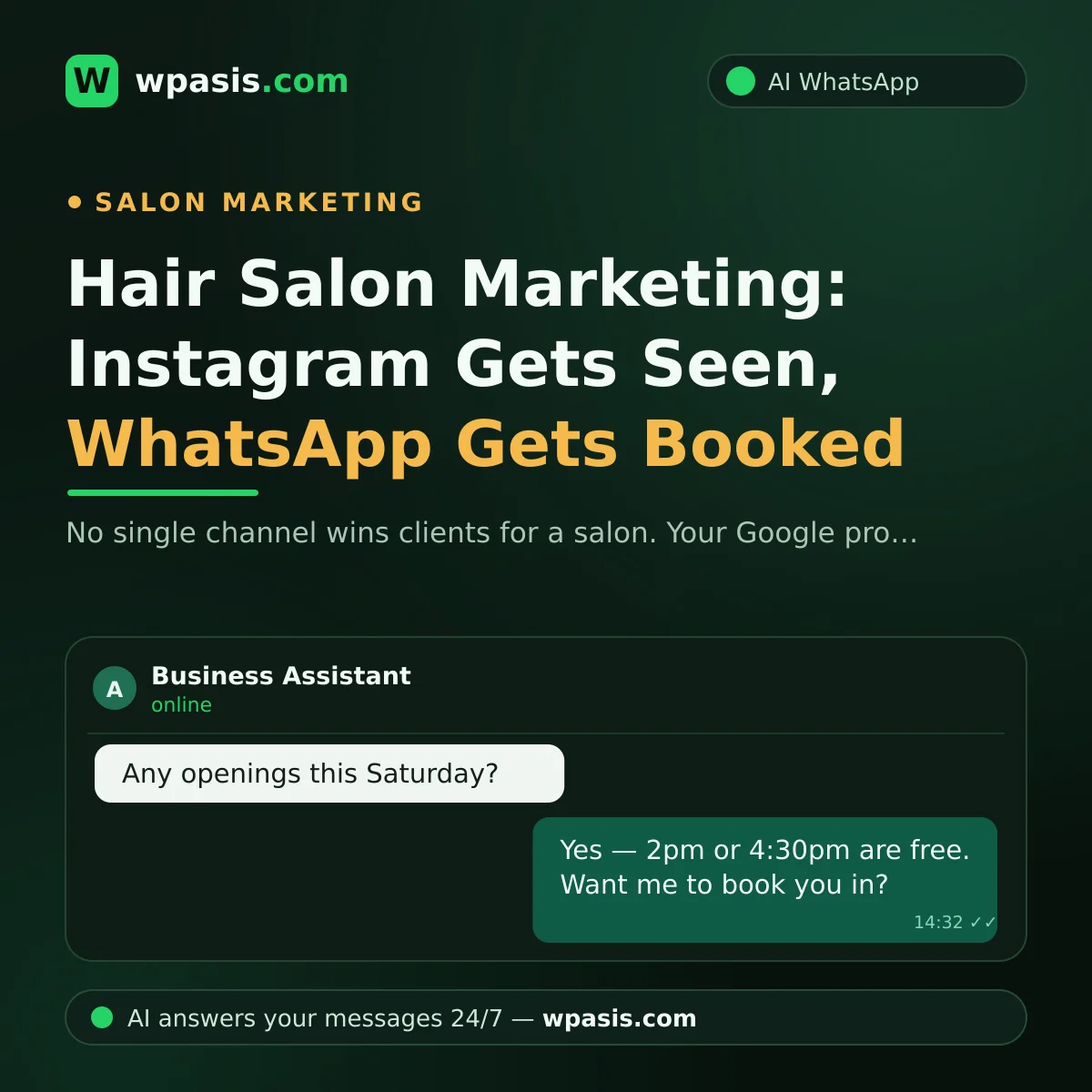
An AI assistant. A system that draws on your salon's own information and answers incoming messages on the business's behalf. It knows your services, your hours, how long things take, and it takes bookings. You handle the scissors, it handles the messages.
Which one suits you depends on your message volume. Five messages a day? Templates are fine. Thirty a day and you're missing half of them? Different story.
The Catalogue and the Price Question
"How much is it?" is the single most repeated question you'll get. Typing that out by hand every time is dead time.
The catalogue feature in a WhatsApp Business profile helps here: you list your services with photos and descriptions and share the whole thing in one tap. Setup is covered in How to Create a WhatsApp Catalogue.
Just remember that salon pricing varies by person. Hair length, current colour, the type of process — all of it moves the number. Giving a "from" price in the catalogue and pinning it down in conversation is the honest way to do it.
Leg 3: Staying in Touch — Loyalty
Winning a new client is expensive. Bringing an existing one back is cheap. Yet most salons do it backwards: forever chasing new faces while the old ones quietly drift.
Hairdressing is repeat work. Cuts and root touch-ups come round on a rhythm, and while that interval varies by person and by service, you already know your own clients' cycles. You can roughly predict when they'll be due.
Appointment Reminders
The basics. A short message the day before cuts down no-shows. An empty chair caused by someone forgetting is a fixable loss.
Tone matters. Write it without pressure and make cancelling easy. A cancelled appointment beats a no-show, because you can give that slot to someone else. For wording, see Appointment Reminder Message Examples.
The "You're Due" Nudge
When a client's cycle is coming up, they're probably already half-thinking about it. A polite message in that window can turn into a booking.
One caution: this is not a promo blitz. Personal, genuinely relevant, infrequent. A bulk message blasted to everyone at once annoys people and puts your number at risk. We explained why in WhatsApp Bulk Messaging: Penalties and Risks.
A Cancellation Policy
The most irritating thing in any salon is the last-minute cancellation. A written policy, stated upfront, protects you and heads off the argument. How to Write an Appointment Cancellation Policy covers the drafting.
Putting the Triangle Together
All three legs in one line:
Google gets you found. WhatsApp gets you booked. Follow-up gets them back.
Instagram isn't outside this triangle — it sits alongside Google on the "being found" side. That's where you build the feel of the brand. But the link in your profile should go straight to WhatsApp. Someone who likes what they see should be able to message you within two seconds.
The practical flow looks like this:
- Someone sees you on Instagram or Google.
- They tap the link in the profile and WhatsApp opens.
- They message, get a fast answer, and the booking happens.
- A reminder goes out before the appointment, and they turn up.
- A few weeks later they get a polite "you're about due" message.
The link that breaks most easily is step three. Because that's where a human has to pick up a phone, and that human is usually busy.
A Quick Note on Data Protection
If you're storing client numbers and messaging them, you're processing personal data. The basic principles hold pretty much everywhere: collect only what you need, tell people what you're using it for, and make opting out easy.
For the wider picture, see GDPR and WhatsApp. For anything definitive, or an assessment of your own situation, talk to a legal professional.
Where to Start
Don't try to do all of it at once. Go in this order:
This week: Fill out your Google Business Profile completely. Hours, photos, services, WhatsApp link.
Next week: Point your Instagram bio link at WhatsApp. Set up the greeting message and quick replies.
After that: For one week, count how many messages you answered late. If the number bothers you, look at automation.
Ongoing: Make appointment reminders routine. Then add review requests and the "you're due" nudges.
None of this is unique to hair, by the way — the same logic applies to any appointment-based business. We looked at a similar structure for a different trade in Tattoo Studio WhatsApp Booking.
Frequently Asked Questions
Should I delete my Instagram account?
Absolutely not. Instagram is your shop window and it's where your brand perception lives. What you should stop doing is treating it as a booking system. Keep posting — just route anyone who wants an appointment to WhatsApp via the bio link.
I run a small salon. Do I really need all this?
The "system" here isn't complicated software; it's three channels set up properly. Even in a one-chair salon, the Google profile should be complete and messages should get answered on time. If anything, solo operators need it more, because the person doing the work and the person answering the phone are the same person.
Will an AI assistant sound like a robot to my clients?
A well-configured assistant draws on the salon's own information and speaks in your voice. It knows your services, your hours, how long each treatment takes. When something comes up it isn't sure about, handing the conversation over to you is the correct behaviour. You can watch conversations from the panel and take over whenever you like.
How often should I message my clients?
Only when it's genuinely relevant. Booking confirmation, a reminder the day before, and one polite nudge when their cycle is due. Promo messages beyond that both dilute the effect and irritate people. Fewer, well-timed messages always outperform lots of unnecessary ones.
If you can't keep up with the messages at your salon, it may be worth seeing how an AI assistant that connects to your business's existing WhatsApp line actually works. Setup is done with a QR code — no code, no technical knowledge required. For details and current pricing, have a look at wpasis.com.