5-a-Side Pitch Booking: Filling Every Empty Slot With WhatsApp
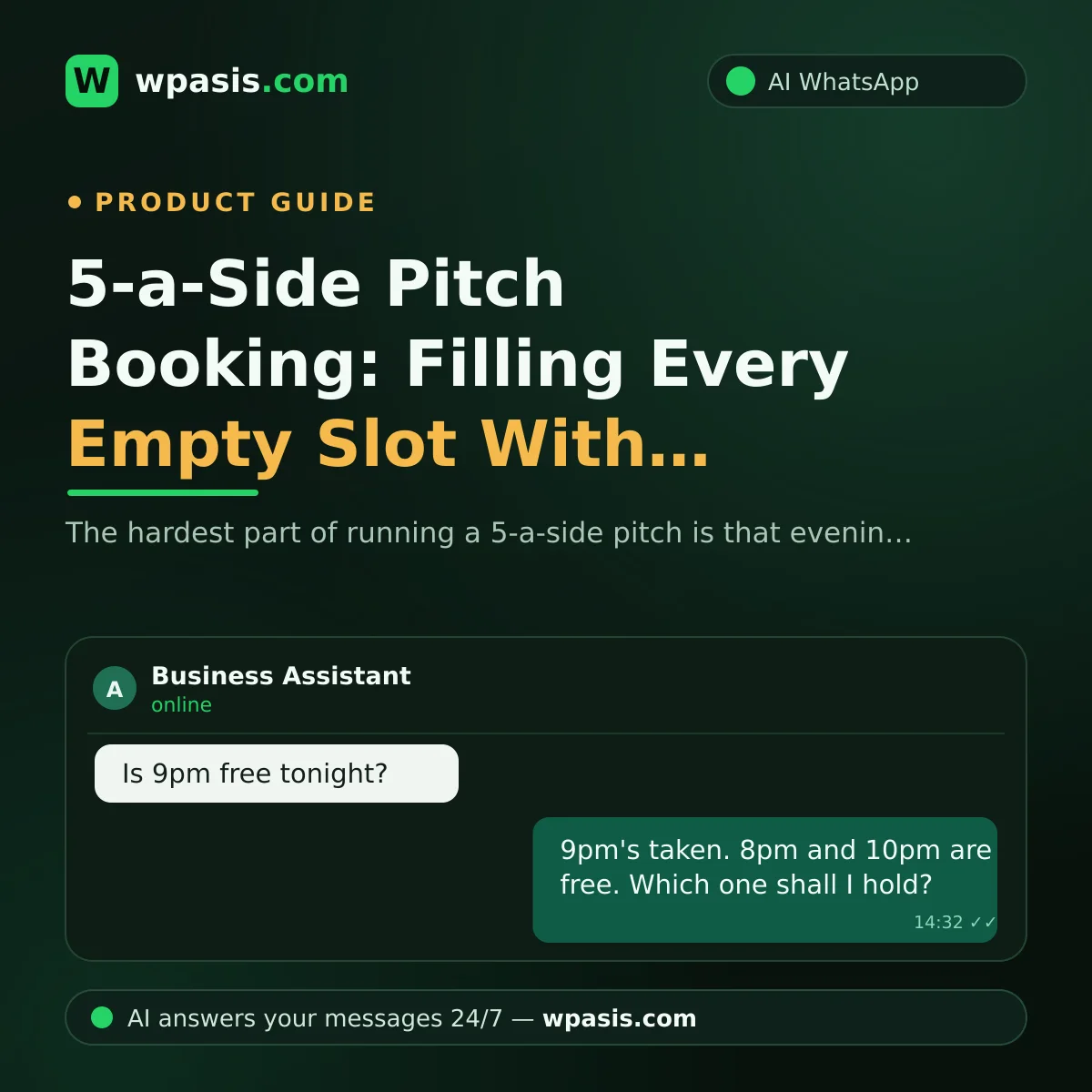
If you run a 5-a-side pitch, most of your day is one question on repeat: "Mate, is 9pm free tonight?" From the outside, pitch booking looks simple — there are slots, they fill up. From the inside it's a different story: you've promised the same slot to three different groups, the team that never paid a deposit never turns up, and when a group cancels, that hour just sits empty because you had no time to refill it.
This guide walks through the whole booking process, from availability queries and group bookings to deposit policy and last-minute slot filling. And the focus is this: how do you run it as a clean workflow on WhatsApp instead of on the phone?
What's Actually Going Wrong With Pitch Bookings?
Most operators say "I'm too busy to keep up." But look closely at the busyness and the picture usually looks like this.
Demand isn't spread evenly across the day. Weekday 7pm-11pm gets fought over; daytime slots sit almost empty. So your problem isn't "too many customers" — it's demand crammed into a narrow window.
The second problem: the questions repeat. Most incoming messages ask three things — which slot is free, what does it cost, is there a deposit. These aren't hard questions to answer. They're just asked constantly.
The third problem: you're out on the pitch. While a match is running, while you're switching the floodlights on, while you're handing out bibs — you can't look at your phone. By the time you reply an hour later, that group has already booked the place down the road.
The way to solve all three isn't working harder. It's building a system that can answer for itself.
Automate the Availability Question
This is the heart of booking management. A customer can't decide anything until they know the slot, and until you reply, they're just waiting.
What a good availability reply looks like
"Free" or "booked" isn't enough. A good availability reply does three things at once:
- States the status of the slot they asked about
- If it's taken, offers the nearest alternative slots on the same day
- Names the next step (how the booking gets confirmed)
For example: "9pm is booked tonight, but 8pm and 10pm are free. Which one shall I hold for you?" That reply doesn't lose the customer — it just moves them. Some of the bookings you lose are probably lost the moment someone hears "booked" with no alternative and the conversation ends. It's worth watching your own line and testing that.
Think in weekly calendars
Most customers aren't after a one-off game — they want a regular one. "Every Tuesday at 9pm." Keep these groups under their own heading and lock their fixed slots into your calendar. A regular group is your most valuable customer, because it means predictable income.
An AI-powered assistant running on WhatsApp can learn your schedule and your rules, and answer these queries even while you're out on the pitch. We covered how to set that up step by step in how to build your business knowledge base.
Name One Point of Contact for Group Bookings
Fourteen people show up to the pitch, but one person made the booking. The trouble is that sometimes four of those fourteen message you separately.
Set a simple rule: every booking has exactly one point of contact. Whoever opens the booking is the captain; cancellations, time changes and deposits all go through them.
You also need to tell the customer this. Add one line to your confirmation message: "You're the contact for this booking — just send any changes from this number."
What you need on record for group bookings:
| Detail | Why it matters |
|---|---|
| Captain's name and number | The single-contact rule |
| Date and time | Prevents double booking |
| Deposit status | Measures no-show risk |
| Regular or one-off | Calendar planning |
The table looks basic, but most pitch-booking chaos comes from these four fields never being written down.
Deposit Policy: An Unwritten Rule Isn't a Rule
Deposits are the touchiest subject in this business. Don't ask for one and no-shows go up; ask too firmly and customers walk away. The balance lives in a written policy.
What the policy must cover
The deposit amount and how it's paid. Don't leave it vague. "Depends" means negotiating separately with every single customer.
Which bookings require it. Asking for a deposit only on weekends and slots after 7pm, for instance, is a reasonable approach — because those are the hours where a no-show actually costs you.
The refund condition. Up to how many hours before can they cancel and get the deposit back? 24 hours is a common threshold, but depending on how fast your slots refill, 12 might work.
Any exceptions. If you treat regular groups differently, write that down too.
Once it's written, the critical step is showing it to the customer at the moment of booking. A rule you mention afterwards doesn't feel like a rule. For a detailed framework on wording the cancellation terms, see how to write an appointment cancellation policy.
The legal side of deposits (prepayments, cancellation fees and similar concepts) varies by business type and jurisdiction. Before you commit your policy to writing, it's worth checking with a legal professional.
Turn Cancellations Into Openings, Not Losses
Cancellations will happen. It rains, the captain gets called into work, the team is short. The point isn't preventing them — it's refilling the freed-up slot.
What should happen the moment a cancellation lands?
At most pitches, here's what happens after a cancellation message: nothing. The slot stays empty, the evening comes and goes.
What should happen is dead simple: check whether anyone's been asking for that slot. And there's a good chance someone has — because earlier the same day, somebody asked about that exact hour and got told "booked."
For this, keep a waiting list. Note down everyone you turn away from a full slot: which day, which time range they wanted. When a slot frees up, tell them first.
How the waiting-list message should read
Short, clear, and time-sensitive — without overdoing it:
"Hi — the 9pm slot you asked about tonight has just opened up. You're first to hear. Want it?"
That single message can refill an hour you'd written off. And WhatsApp is the right channel for it — it's seen straight away and it's easy to reply to.
One caution here: this is not a bulk announcement blasted to everyone on the list at once. It's a reply to the one person who asked about that slot, about their own request. The difference matters; on the risks of bulk messaging, have a look at WhatsApp bulk messaging: penalties and risks.
Managing the Daytime Gap
Evenings are already full. The real growth area for a 5-a-side pitch is daytime.
Daytime slots serve a different crowd, and that crowd needs a different conversation:
Shift workers. A shift ending in the morning can play in the afternoon.
Student groups. Gaps between classes can be flexible.
Corporate teams. Companies ask for lunch-break or early after-work slots.
Training and school groups. Morning hours suit regular, scheduled use.
Reaching these groups usually comes down to pricing and standing arrangements. Rather than leaving daytime completely empty, tying it to a regular group on more favourable terms can make your monthly income far more predictable. How much difference it makes is something only your own occupancy records will show you.
To plan around seasonal swings (the summer dip, the winter rush), customer communication in seasonal demand may also help.
The Reminder Message: The Cheapest No-Show Insurance There Is
A short reminder sent a few hours before the booking is the simplest tool for cutting no-shows. Include: date, time, pitch number, a link to the address, and the cancellation deadline.
For example:
"Hi — reminder about your 9pm booking today. Pitch 2. If you need to cancel, please let us know by 7pm at the latest."
The power of this message isn't in the reminder. It's in pulling cancellations earlier. A cancellation you hear about early is a gap you can fill. One you find out about at kick-off is simply a loss.
For ready-made templates, see appointment reminder message examples.
Running Your Pitch Booking System on WhatsApp
Every step above is really just an exchange of messages. The slot question, the deposit details, the confirmation, the reminder, the "it's free now" nudge. All of it already happens on WhatsApp — the problem is that you are the one doing it.
That's exactly where WpAsis comes in. It connects to your business's existing WhatsApp line, learns your schedule and your rules, and replies to incoming messages on your behalf around the clock. It answers availability questions, takes bookings, and handles frequently asked questions. Setup is done by scanning a QR code — no code, no technical knowledge required. You watch every conversation from the panel and take over whenever you want to.
The judgement calls — bending a deposit rule, a special discount, a standing arrangement with a regular group — stay with you. The assistant takes the repetitive load.
If you're not sure where to begin, the small business digitalisation roadmap is a good starting point.
Frequently Asked Questions
Will asking for a deposit scare customers off?
A written, reasonable deposit policy generally doesn't; uncertainty does. If a customer knows the answer to "how much is the deposit, and what happens if I cancel" from the outset, they don't hesitate. Applying deposits only to peak evening and weekend slots — rather than every hour — is also a common way to strike the balance.
Can an AI assistant create a double booking?
The assistant answers based on your rules and your booked slots, and you see every confirmed record in the panel. If you'd still rather approve the peak slots yourself, you can set the flow up as "the assistant gives the information, you confirm the booking." For what to do when the assistant does get something wrong, read what if your AI assistant gives a wrong answer.
Is storing customer numbers a data protection problem?
When you process customer contact details you need a purpose, a retention period, and to inform the customer — under GDPR and most equivalent data protection regimes. With something like a waiting list, keeping this transparent matters. For the general framework, see data protection and WhatsApp; for definitive guidance on your own situation, consult a legal professional.
How big does a pitch need to be for this to make sense?
Look at message volume rather than the number of pitches. Say you're a single-pitch operation taking 30-40 availability queries a day — that means most of them are asking the same three questions, and those can be automated. If you're running the place on your own, the load is even more obvious; customer management in a one-person business focuses on exactly that scenario.
In pitch booking, the winner isn't the operator who reads the most messages. It's the one who refills an empty slot the fastest. If you want your WhatsApp line to do that for you, take a look at WpAsis at wpasis.com — current pricing is on the same site.