How to Use WhatsApp for Eye Clinic Appointment Management
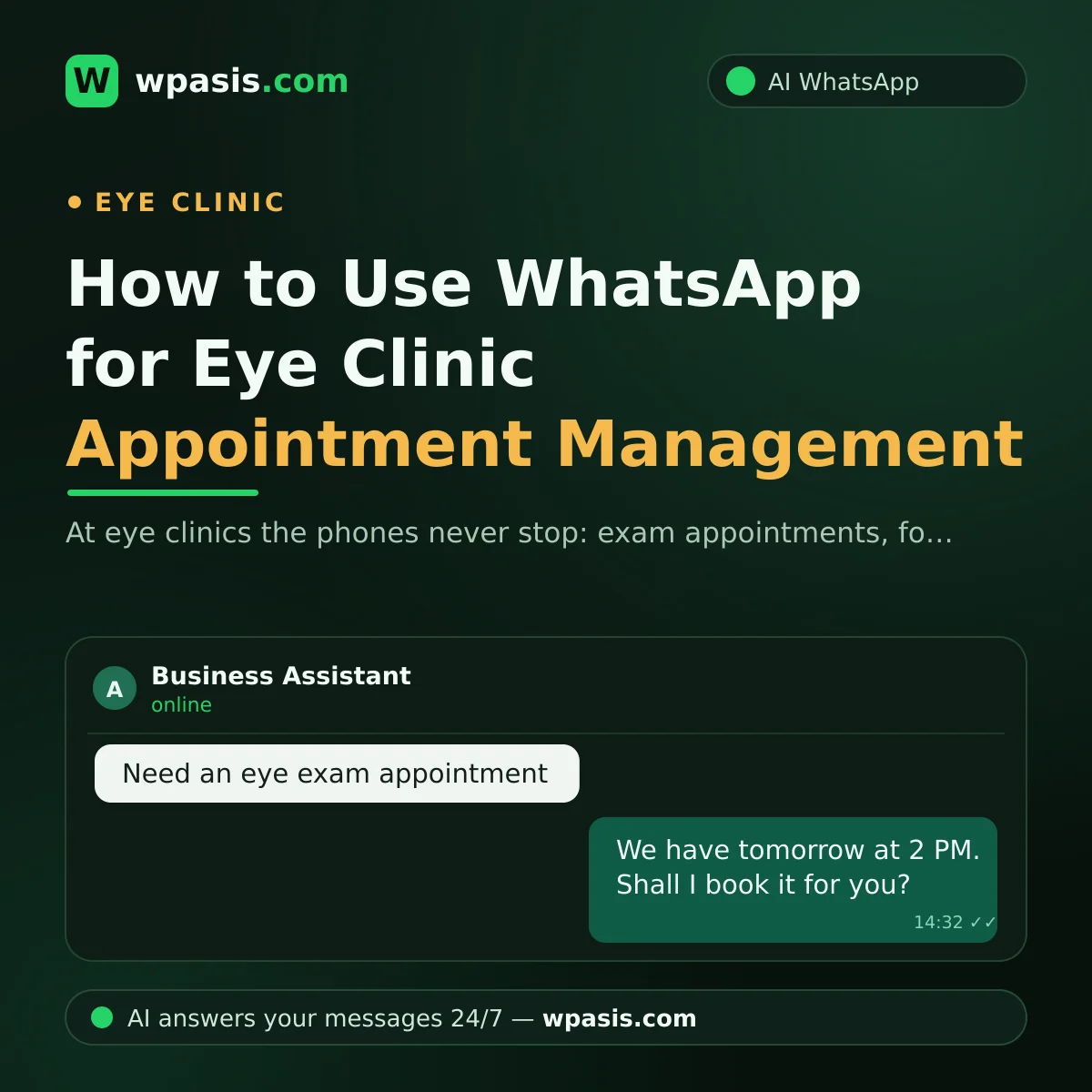
Eye clinic appointment traffic is among the heaviest in all of healthcare. The eye is an area everyone, at every age, needs regular check-ups for: a parent getting glasses prescribed for their child, a patient coming in for a yearly check, an older patient who's lost track of their post-op follow-up date, a young person asking "Do you do contact lens fittings?" They all write to the same line, and most of them outside working hours. The front desk can't keep up with the phone, patients wait for answers, and every missed message is a patient who goes to another clinic. In this article we'll explain how to manage exam appointments and post-op follow-up over WhatsApp with AI.
The Challenges in the Eye Clinic Appointment Process
If you look at the messages your clinic's front desk gets over a single day, the picture is roughly this:
- "What's the earliest day I can get an appointment for an exam?"
- "When was my follow-up date? I don't remember."
- "Do I need an appointment for a vision measurement?"
- "Is my report ready? When can I pick it up?"
- "What are your working hours? Are you open on Saturday?"
Almost all of these questions are routine; their answers are fixed and most don't need a doctor at all. But each one takes up the front desk's time. Let's say your clinic gets 50 messages a day and each takes an average of two minutes; that's about an hour and a half a day going to messaging alone. At busy times messages pile up, replies lag, and the patient who wants to book gives up on waiting.
The second big challenge is follow-up tracking. Post-surgery or post-treatment check-ups matter for how treatment progresses, but patients forget their follow-up dates. Calling, reminding, and rescheduling no-shows becomes a full-time workload when done by hand.
Automating Eye Clinic Appointments and Follow-Up on WhatsApp
Your patients already message on WhatsApp; the point is to be able to answer the moment they write. A WhatsApp AI assistant like WpAsis connects to your clinic's existing number with a QR code; no technical knowledge or new number needed. From there, the process runs like this:
Booking Exam Appointments
When a patient writes "I'd like to book an appointment," the assistant asks which department or procedure they're coming for and which days work, then creates the appointment. Even a patient writing at 11 PM completes the booking without waiting. When your front-desk team checks the panel in the morning, they find the appointments created overnight ready to go; they can take over any conversation to manage it personally.
Post-Op Follow-Up Reminders
A gentle reminder goes out over WhatsApp to a patient whose follow-up date is approaching: "Your follow-up appointment is tomorrow at 10:30 AM. We'll be expecting you, get well soon." This simple touch dramatically reduces forgotten follow-ups. If the patient needs to reschedule, the assistant offers alternative times and creates the new appointment. For ready-made templates for different situations, see our article on appointment reminder message examples.
Let's draw the line clearly here: post-op messages like "There's redness in my eye, is that normal?" require medical assessment. The assistant never comments on such questions; it immediately directs the patient to call the clinic or see the doctor and hands the conversation to your team. For any health symptom, definitive information can only be given through a doctor's examination.
Routine Information Questions
Questions like working hours, address, parking, which exams and procedures you offer, and what to bring to an appointment are answered instantly from the assistant's knowledge base. You add all your clinic's practical information to the knowledge base, and the assistant answers every patient with the same accuracy, in a friendly tone.
Patient Experience: Speed Builds Trust
In healthcare, a patient's experience at the first point of contact largely shapes their judgment of the clinic. A patient who can't get a reply for hours forms, without realizing it, the impression that "things move slowly at this clinic." A patient who gets a courteous greeting within seconds and books an appointment in two minutes trusts you before they've even walked through the door.
One way to strengthen this experience is to make it easier for patients to reach you. So that a patient who finds your clinic on Google can jump to WhatsApp in one tap, don't forget to add WhatsApp to your Google Business Profile. Search, profile, message, and appointment, all completed in one flow.
On your clinic's side, the gain is clear: the front desk is freed from the phone-and-message load and focuses on the patient in the room; the appointment book keeps filling day and night; and thanks to follow-up reminders, tracking doesn't slip. You follow every conversation from the panel, and any team member can take over a chat whenever they want.
Let's give a concrete example: at 10 PM a patient writes, "Is there an exam appointment for tomorrow?" The assistant offered suitable times, took the patient's name and preferred slot, created the appointment, and reminded them to bring their old glasses or prescription if they had one. The next morning the front desk saw the ready appointment in the panel. No one worked extra hours, but the patient met a clinic that got back to them within two minutes, even late at night.
Sensitive Data and Ethical Boundaries
Two boundaries need attention in eye clinic communication. The first is the medical boundary: the assistant never, under any circumstances, makes a diagnosis, recommends treatment, or comments on the use of medication or drops. The only correct answer to such questions is a doctor's examination, and the assistant directs the patient there.
The second is the data boundary: health information is the most sensitive category of personal data. When corresponding with patients over WhatsApp, obligations like the duty to provide a privacy notice and explicit consent under data protection law apply. To learn the general framework, you can read our article on GDPR and WhatsApp; for definitive guidance specific to your clinic's process, be sure to consult a legal expert.
Frequently Asked Questions
Does the assistant give patients medical information?
No. The assistant only answers administrative matters like appointments, working hours, address, and preparation details. If a question about a symptom, treatment, or medication comes in, it directs the patient to the doctor without commenting and hands the conversation to your team.
How do post-op follow-up reminders work?
A reminder message is sent over WhatsApp to a patient whose follow-up date is approaching. If the patient isn't available, the assistant offers alternative times and updates the appointment. That way forgotten follow-ups drop and the tracking routine holds.
Will our existing clinic number change?
No. WpAsis connects to your existing WhatsApp line, the one your patients already know, with a QR code. Nothing changes on the patient's side; the only difference is that answers now arrive 24/7 and within seconds.
Is our front desk being sidelined?
Quite the opposite, your team is freed from the routine load. The assistant takes on repetitive questions and appointment tasks; your team follows every conversation from the panel and takes over a chat in one tap for sensitive or special situations. The last word is always with a human.
Let your appointment book fill day and night and keep your follow-ups on track. Try a free demo at wpasis.com; run a live test with your clinic's information in minutes.