Dental Clinic Appointment System: Stop Losing Patients on WhatsApp
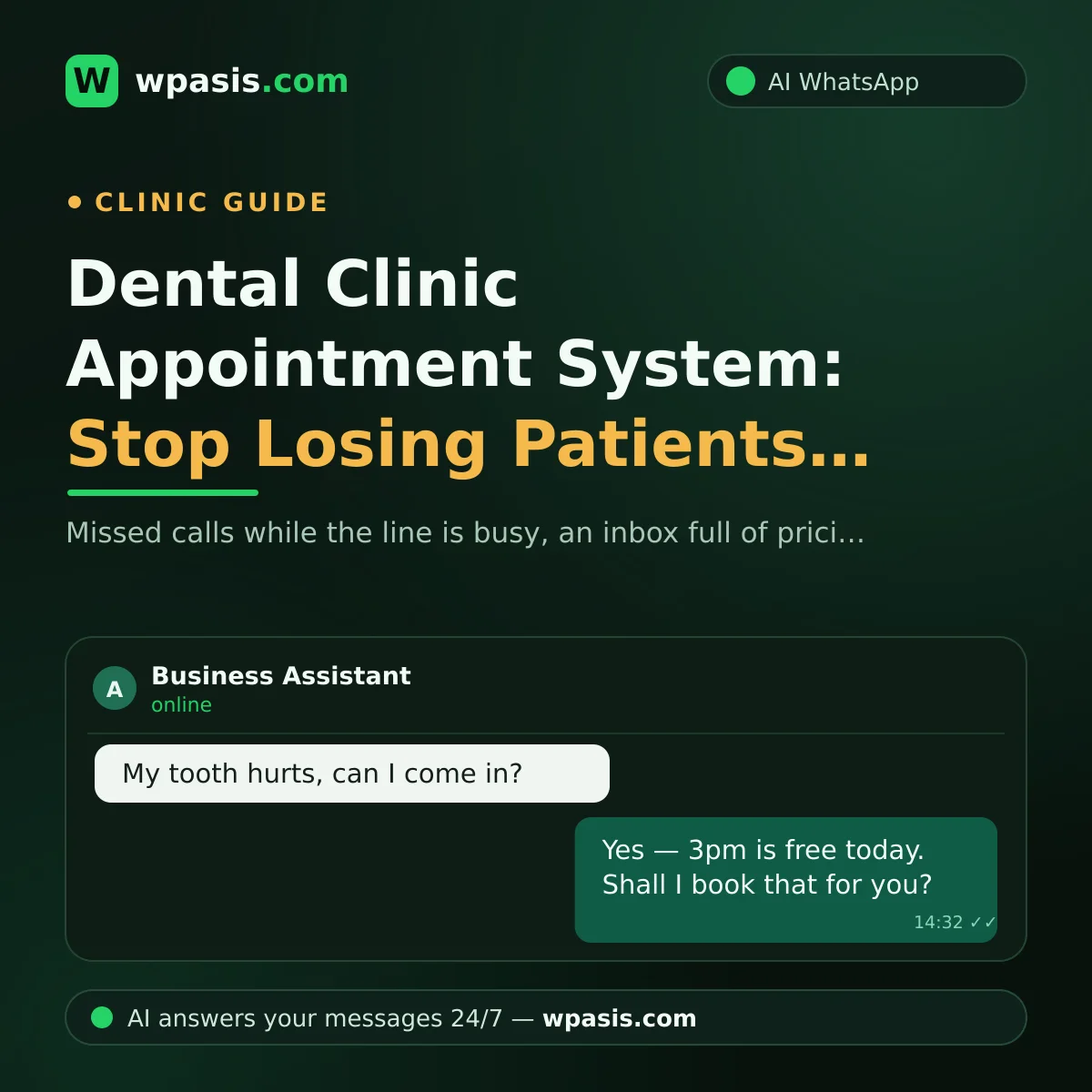
In a dental practice, the phone never really stops. One person wants an implant quote, another needs a filling appointment, a third messages "My tooth is killing me — can you see me today?" You're chairside with a patient, so you can't pick up. Your receptionist can't greet the person at the desk and juggle two lines at the same time. A properly built dental clinic appointment system earns its keep exactly here: it stops every missed call from turning into a missed patient.
This guide covers what a WhatsApp-based appointment system actually does for a dental practice, how to handle the endless stream of pricing questions, and how to shrink the no-show problem.
The Missed Call Nobody Counts
Picture a mid-sized practice handling 30 to 40 calls and messages a day. That's a hypothetical number, but it makes the picture concrete: even during opening hours, some of that traffic goes unanswered. The phone that rings mid-procedure doesn't get picked up. The messages that pile up over lunch never get caught up on. And the patient who writes at eight in the evening with toothache either waits until morning — or doesn't, and messages another practice instead.
Dental problems rarely wait politely. A patient in pain goes to whoever answers first. So an unanswered message isn't just an unanswered message; it's most likely a patient now sitting in someone else's chair.
Hiring another receptionist is the obvious fix, but it's expensive and it doesn't solve the real problem: evenings, weekends, and peak hours still go dark. What you actually need is something that can respond instantly, around the clock.
Why Build the Appointment System on WhatsApp?
Your patients are probably messaging you there already. People don't want to download a new app, create an account, and pick a password just to reach a business. They want to fire off two lines in the app that's already open on their phone.
Making WhatsApp your booking channel has concrete advantages for a dental practice:
- Zero friction for the patient. No downloads, no forms, no sign-up. If they can send a message, they can book.
- The thread doesn't disappear. The patient can scroll back to see their date and time; you can look back and see who asked for what.
- Photos are effortless. A chipped tooth, swelling, or an old X-ray arrives as an image, so the dentist has a rough idea before the patient walks in.
- More flexible than a call. Patients can message from a meeting, a commute, or their desk. You stay reachable at hours a phone line simply isn't.
If you're moving off a paper appointment book and a landline, it's worth planning that transition properly — WhatsApp is the gentlest place to start.
Answering Pricing Questions Without Drowning in Them
The busiest topic in a dental inbox is almost certainly price: "How much is an implant?" "What do zirconia crowns cost?" "What's the price for whitening?"
Most of these questions are near-identical, yet typing an individual reply to each one eats real hours. And plenty of practices don't want to quote a firm number before an exam, because the treatment plan varies patient to patient. A single implant and a full-arch case can't carry the same price.
An AI-powered WhatsApp assistant does two jobs here at once:
- It replies instantly, within your pricing policy. Something like "The treatment plan is confirmed after an examination — shall we book you a consultation?" goes out in the framing you defined. The patient isn't left hanging, and you don't lose minutes per message.
- It turns the price question into an appointment. Someone asking about cost is a patient with intent. A patient who gets an immediate answer and an offered slot doesn't drift to another practice while waiting.
Cut No-Shows with Appointment Reminders
A patient who doesn't turn up and doesn't call (a no-show) means an empty chair. Nobody else was booked into that slot, the dentist and nurse are ready, and nothing gets done. Dental appointments tend to run long, so a single no-show can take out a meaningful chunk of the day.
The simplest, most effective countermeasure is a reminder before the appointment. WhatsApp is ideal for this, because it's an app the patient already opens throughout the day. A good reminder includes the date and time, the procedure, and a polite "please let us know if you can't make it" — for ready-made wording, see our appointment reminder message examples.
Beyond reminders, we've collected confirmation requests, easy cancellation, and filling freed-up slots in our guide to reducing no-shows.
What a Good Dental Appointment System Needs
There are plenty of options out there. When you choose, look past the brand name and check for these:
- 24/7 automatic replies. The patient in pain at midnight shouldn't wait until morning. AI-powered systems handle this without extra staffing costs.
- Simple setup. It shouldn't need code or technical skill. A system you can start in minutes by scanning a QR code beats waiting on an agency or a developer.
- Knowledge specific to your practice. It should answer using your treatments, your opening hours, your dentists, and your policies — not generic boilerplate. Systems that learn from your own website have an edge here.
- Human handover. When a complex clinical question or a sensitive situation comes in, your receptionist or dentist must be able to take over the conversation in one click.
- Conversation visibility. You should see every thread from a dashboard and track who asked for what without anything slipping.
- Multi-language support. For practices treating patients from abroad, replying in the patient's own language makes a real difference.
How a WhatsApp AI Assistant Works in a Dental Practice
WhatsApp AI assistants like WpAsis connect to your practice's existing WhatsApp line — no new number required. Setup is a QR code scan, with no technical knowledge needed.
The system reads your website to build a knowledge base specific to your practice: which treatments you offer, your opening hours, your address. When a patient asks something, the AI answers on your behalf using that information, takes appointment requests, handles frequently asked questions, and switches languages when needed.
You stay in control throughout: you watch every conversation from the dashboard, and a human can take over at any moment. The AI absorbs the volume; diagnosis, treatment planning, and anything requiring clinical judgement stay with you.
One important note: patient information is personal data, and in healthcare it's usually treated as a special category. Running patient communication over WhatsApp means taking privacy notices, consent, and data retention seriously under the data protection rules that apply to you — GDPR in the UK and EU, HIPAA and state law in the US. This article isn't legal advice; consult a qualified professional before you rely on any of it.
Conclusion: Keep the Chair Full and the Phone Answered
The two most valuable things in a dental practice are the dentist's time and the chair's occupancy rate. An appointment system built on WhatsApp turns missed calls into bookings, lifts the weight of pricing questions off your shoulders, and cuts empty chairs with reminders. It does all this without making your patient download anything or handing you a technical project.
If you'd like a closer look at how it would work in your practice, visit wpasis.com.
Frequently Asked Questions
Do I need technical knowledge to set up a WhatsApp appointment system?
No. With solutions like WpAsis, setup is a QR code scan — no code, no developer. You scan your existing WhatsApp line, tell the system about your practice, and it starts replying.
Can I keep using my current WhatsApp number?
Yes. The system connects to the WhatsApp line your practice already uses. The number your patients have saved doesn't change; the number on your business cards, your signage, and your Google listing keeps working exactly as before.
Could the AI give patients wrong clinical advice?
The assistant doesn't diagnose and doesn't recommend treatment; it answers within the boundaries of your own knowledge base. It handles bookings, opening hours, and treatment types. For anything that needs a dentist's judgement, a human can take over the conversation from the dashboard at any moment, and every thread stays visible to you.
How much does a dental clinic appointment system cost?
Pricing depends on the features you choose and your usage volume. With monthly subscription models, the comparison against the cost of extra staff is usually straightforward. For current plans and pricing, visit wpasis.com.