WhatsApp Client Management for Caregiver Agencies
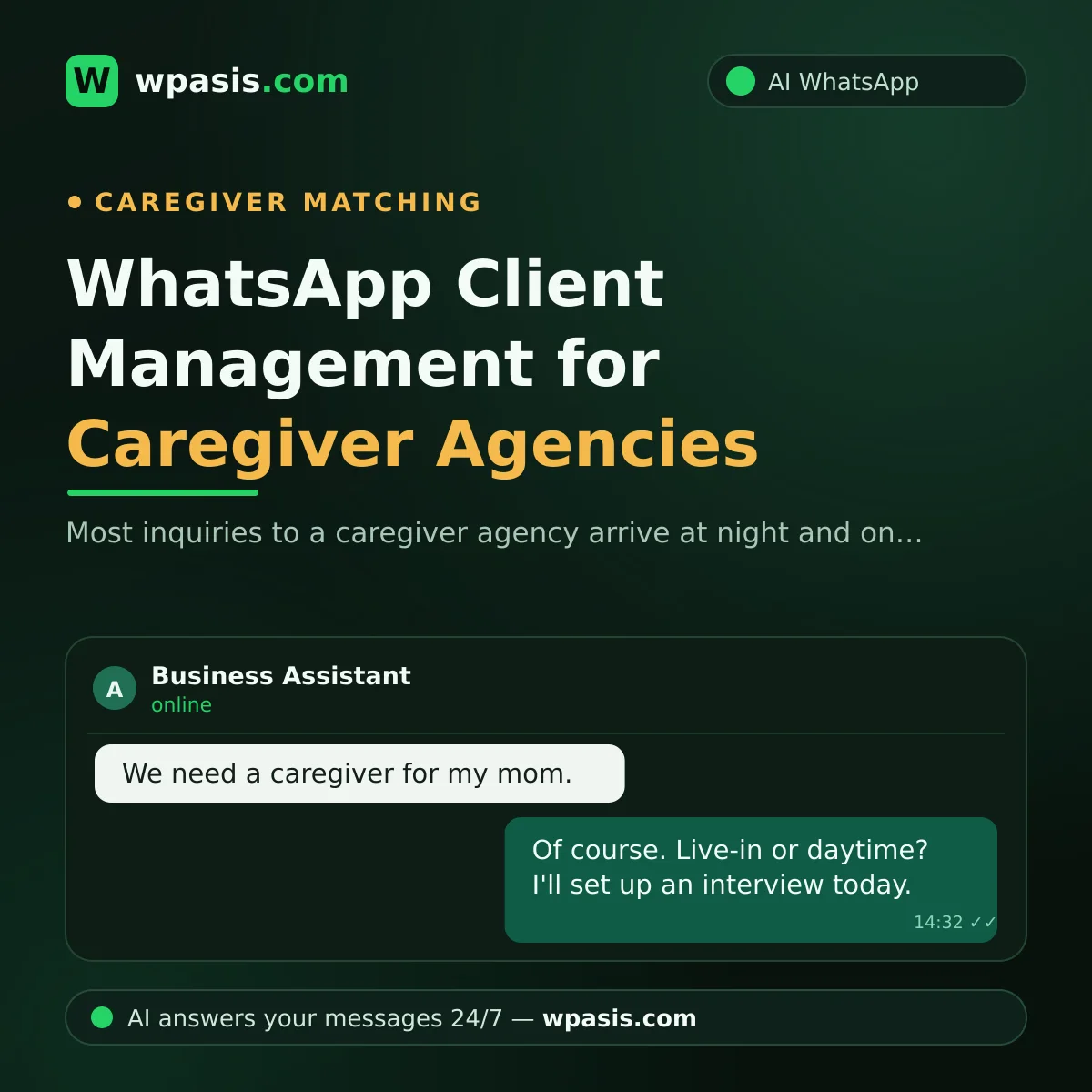
A family whose relative has just been discharged from the hospital usually starts looking for a caregiver in the evening, in a hurry. The first place they reach is the one that answers the phone fastest. If you run a caregiver agency, you know the weight of that sentence: there's no shortage of demand, but the hour the demand arrives rarely matches the hour you can pick up the phone. In this article, we'll walk step by step through how to bring order to the whole process, from needs assessment to interview scheduling, over WhatsApp.
The Most Common Problems in Caregiver Agency Communication
Look closely at an agency's daily communication and three bottlenecks stand out.
The first is the timing of first contact. Families in the decision phase talk to several agencies at once; the one who calls back first wins. If you return an after-hours inquiry at noon the next day, the family has most likely already signed with someone else.
The second is conversations that start with missing information. Half of the first phone call with a family who says "we need a caregiver" is actually spent asking standard questions: how old is the patient, what's their condition, live-in or daytime care, which area do they live in. If that information were gathered up front, you could look after twice as many families in the same amount of time.
The third is lost follow-ups. Requests jotted in a notebook, missed calls, families you said you'd "call back tomorrow" and never did... Let's make it concrete: say 25 new inquiries come in a week and 5 of them get lost in the rush. That means a meaningful chunk of business evaporates every month for no reason other than forgetfulness.
Needs Assessment on WhatsApp: Ask the Right Questions Up Front
The first link in the solution is starting the needs assessment the moment the first message arrives. The AI assistant connected to your WhatsApp line gently structures the conversation when a family writes "Hello, we're looking for a caregiver for my mother," and asks the questions you've defined, in order:
- Who is the care for; what is their age and general condition?
- Is live-in, daytime, or support at specific hours needed?
- Which city and area is service needed in?
- When should care begin; is it urgent or planned?
- Is there any particular quality expected (experience, language, companionship background)?
The order and content of the questions are entirely yours; the assistant takes them from the framework you've prepared. We explained how to build that framework in our business knowledge base guide. The result: when you check the panel in the morning, you find not a scattered "call me" message, but a tidy summary of needs.
There's an important boundary here. The assistant gathers information and manages the process; it does not, however, assess the patient's medical condition or make a clinical judgment about the type of care. Reminding the family that they should consult their physician for definitive guidance on which care model is appropriate is both correct and protective of your agency.
How Does Caregiver Matching Get Faster?
If the needs assessment is done well, matching gets half as hard. You now have a clear request in hand, "live-in, weekdays, this area, starting on this date," and scanning your roster for suitable candidates against that criteria takes minutes.
The assistant stays involved at this stage too: it tells the family how the process will unfold, sending an expectation message you've defined, like "We've received your request; we'll identify caregiver candidates that fit your criteria and get back to you within [timeframe]." Because the family isn't left in limbo, they don't call again and again, and you get to focus on the selection.
The matching decision itself is human work, and it should stay that way. The AI's job isn't to decide, but to shorten the road to the decision: gathering the information completely, keeping the family informed, and freeing you from needless phone traffic.
The Interview Scheduling Flow for Caregiver Agencies
Once a candidate is identified, it's time for the family and the caregiver to meet. At most agencies this step loses days to back-and-forth phone tag and "when are you free" volleys. In the WhatsApp flow, it works like this:
The assistant offers the family suitable interview options: in person, by phone, or by video? Then it presents available days and times based on your calendar; the family picks one. Once the interview is set, a confirmation goes to both sides. The day before, both parties get an automatic reminder, cutting down on forgotten appointments and wasted travel.
The process doesn't break off after the interview either: the assistant sends the family a courteous follow-up, and if a decision has been made, confirms the starting details on your behalf.
Sensitive Data and Privacy: Boundaries to Watch
Patient care involves health information by nature, and health data is treated as sensitive (special-category) personal data under regulations like HIPAA in the US and GDPR in the UK and EU. So two rules should be clear from the start: first, ask only for the minimum information needed to plan the service in your messages; detailed medical histories, reports, and documents should not be pulled into the messaging channel. Second, you should have a privacy notice in place that tells families how their data is handled. You'll find the general framework on this topic in our data protection and WhatsApp guide; but when you need definitive guidance for your agency's own processes, always turn to a specialist data-protection consultant or lawyer.
What Does WpAsis Do in Day-to-Day Operations?
You don't need any technical knowledge to set up this whole flow. WpAsis connects to your agency's existing WhatsApp number by scanning a QR code; the number doesn't change, and families keep messaging the line they know.
The assistant is on 24/7: even a family writing from the hospital at 2 a.m. gets an instant reply, and the needs assessment starts that minute. With multi-language support, you can look after international families on the same line too. Every conversation sits in the panel; the moment you sense a sensitive situation, you take over with one click and continue the chat as a human. Speed comes from the machine; warmth and judgment come from you.
Frequently Asked Questions
Won't there be a trust problem if families realize they're talking to a bot?
Transparency builds trust. Having the assistant introduce itself briefly and, when needed, say "I'm connecting you to our team right now" gives families both speed and confidence. Critical conversations are always led by a human; the assistant only handles the groundwork.
How are urgent nighttime inquiries handled?
The assistant responds instantly, gathers the need details, and relays the urgent-case guidance you've defined. When you check the panel in the morning, you find a ready-to-discuss, summarized request; if you like, you can also set up notifications to your team for urgent inquiries.
Does the assistant share caregiver candidates' information with the family?
You decide which information is shared and when. Common practice is for candidate details to be shared by a human at the interview stage; at that point the assistant only manages the process and the scheduling.
Do we need a technical team to set it up?
No. You connect by scanning a QR code with your existing WhatsApp line, and you configure the questions and flow yourself from the panel. There's no code to write or infrastructure to build.
In a sector where the first agency to respond wins, a line that answers 24/7 is your strongest competitive advantage. To try WpAsis at your own agency, request a free demo at wpasis.com.